When discounts destroy margin
People feel this question when the sale week looks alive and the quiet week does not. Revenue jumped. Contribution did not. Someone asks whether the discount made money or whether it trained the next wait.
There is almost no Ads volume on that sentence. The hook is still the one operators bring to a meeting. This page is last in the calendar on purpose. It is not a discount-strategy play and not a “should I discount or raise prices” slug. Those searches are shopper codes and empty volume.
Customer retention in ecommerce already opens on “they only buy on sale.” Ecommerce contribution margin names the line underneath revenue. This page is the sibling on the offer itself. Pull-forward versus incremental, in English.
Fashion markdown and beauty gift-with-purchase belong in the examples. Promo codes as a consumer search do not.
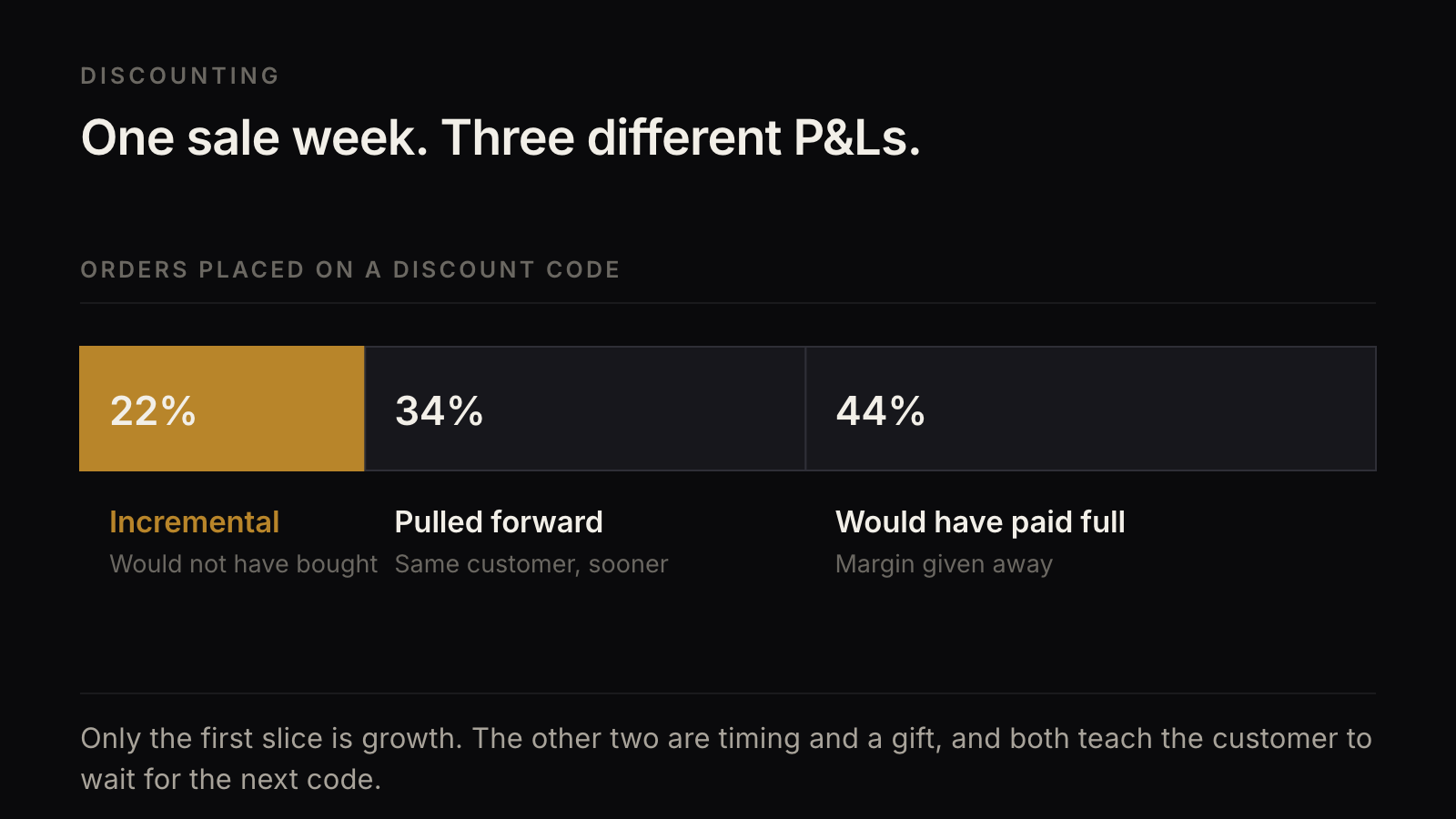
Pull-forward versus incremental
An incremental order is one that would not have happened, at that contribution, without the offer. A pulled-forward order is one that would have happened later, often at a better price.
Both can show up as a successful campaign. Only one grows the month.
Fashion markdown is often pull-forward wearing a clearance hat. The colourway was going to sell to someone who wanted it. You moved them into this week and took 30% off. You also taught the next drop to wait. Ecommerce merchandising is the sibling when the markdown clock was a range bet you already lost.
Beauty gift-with-purchase is often a first-order bribe. The hero might have sold on the empty date. You added COGS and called it marketing. The second order then wants the same gift.
A useful meeting test, said out loud:
- Would this person have bought this SKU in the next replenishment or drop window without the code?
- Did we cut contribution below a line we can defend on this first product?
- Did we just move a branded or email buyer into the ads report?
If you cannot answer the first question, you do not have a promo strategy. You have a week that looked busy.
When a sale trains the next one
The damage is rarely the one code. It is the expectation.
A fashion calendar of 20% off every other Friday will lift “retention” and destroy full-price weeks. The second order arrives. The contribution does not. How to improve customer retention is the how-to order when the first product and the code are mixed together.
A beauty “replenish and save” that fires before the empty date will pull bottles forward and reset the clock. You will call it loyalty. You bought demand you already owned.
Sitewide beats targeted when the meeting wants a simple story. Targeted still destroys margin when the target is everyone who already had the jacket in /cart.
A sequence you can run on one sale
You do not need a full incrementality lab for a first read. You need one offer and the orders under it.
- Name the offer and the first products it sat on. Hold that still.
- Pull orders from the sale window and from the two quiet weeks after.
- Mark each sale order: new to brand, already in cycle, or sitting in cart before the code.
- Reconstruct contribution on a sample of ten, with gift COGS and markdown in the line.
If most of the sample is already-in-cycle or already-in-cart, the sale did not create demand. It priced demand you had.
If contribution on the sample is below the line you would accept on a cold first order, the sale also failed the unit.
Incrementality testing in ecommerce is the page for a holdout when you need a spend decision. This page only needs the offer read. Same idea. Smaller window.
TwoKai starts with the outcome. A sale you can defend, or a stop to paying for a busy week that ate the month. Then we engineer the route.
What's missing
This article can give you pull-forward versus incremental in English, and a short read on one sale. It cannot tell you whether your last code created orders or trained the next wait. That test lives on your orders. You can check what a 20 percent code does to one order at the ROAS calculator.
Related: Is your ROAS target making you money? · Customer retention in ecommerce · Ecommerce contribution margin · Ecommerce merchandising: what to measure under the word · Check break-even on one order
If you want that investigation led as one commercial piece of work, Explore an opportunity with TwoKai.