Ecommerce merchandising: what to measure under the word
Ecommerce merchandising is a wide word. Operators use it for the homepage grid, the collection sort, the lookbook, the app that personalises /collections/, and the person who decides what goes into a drop. Agencies use it for a retainer. Tool vendors use it for ranking.
The useful question is not which app owns the grid. It is what sits under the word. Range. Demand. Markdown. Size and shade. Those are the instruments. The tile labelled “merch” is usually a mix of them.
This is not a Shopify merchandising how-to. That SERP is a Help Center and app stack. Unbranded ecommerce merchandising is the open stem. Fashion and beauty belong in the examples. They do not belong forced into the slug.
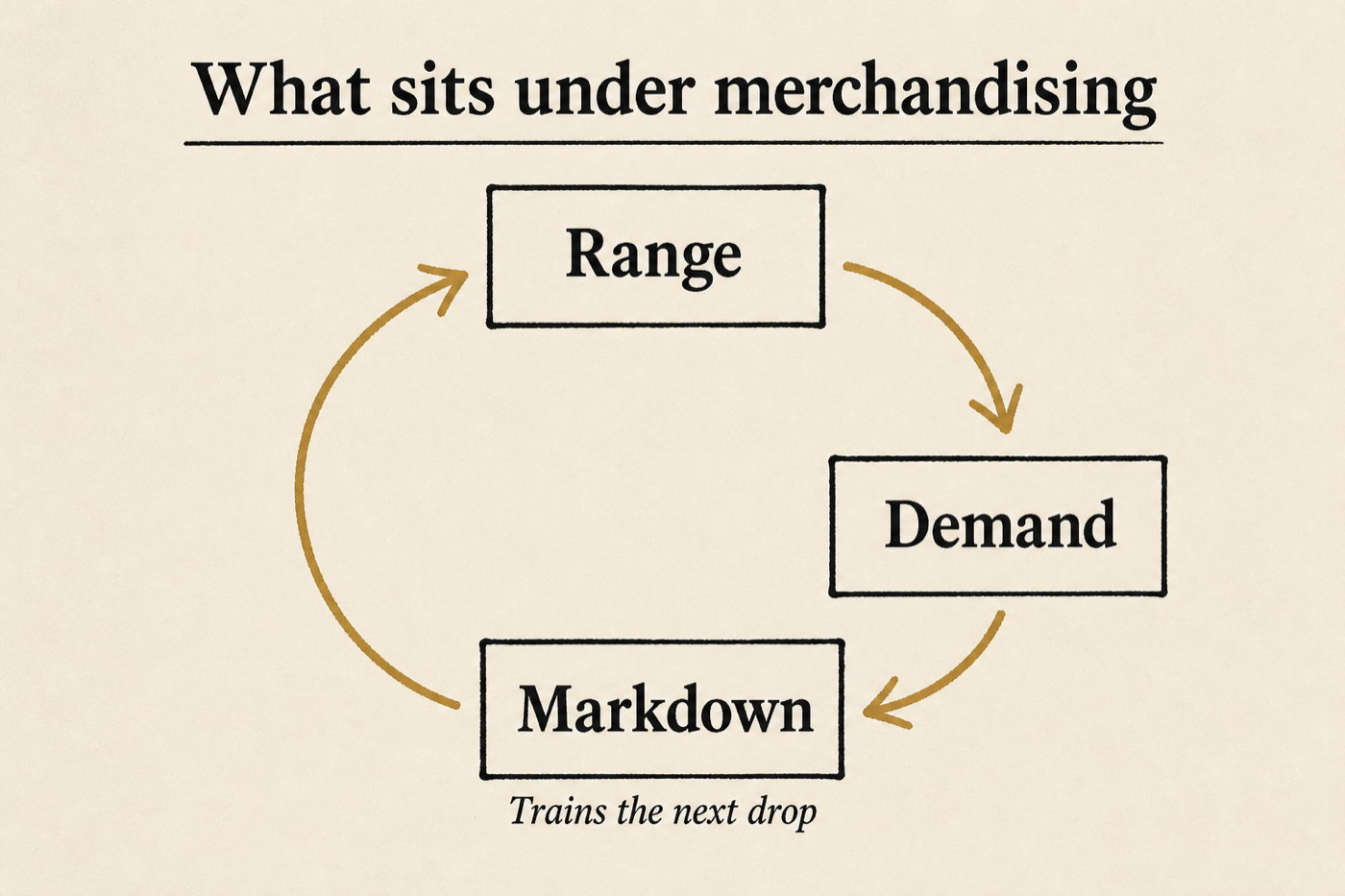
Merchandising is not one number
A collection that “looks full” can hide four different problems.
Range. What you chose to make or buy. How wide the size run is. How many shades. How many one-season colourways you will have to mark down. Range is a bet on demand you have not seen yet.
Demand. What customers actually take, at full price, in which channels. A SKU can be a merchandising hero on the site and a weak order in the data. Paid can make a slow style look like a winner for three weeks.
Markdown. What you give away when the bet was wrong, or when the calendar forced a sale. Markdown is often booked as merchandising. It is a contribution event. It trains the next visit.
Size and shade. The fit and match problem that sits between the image and the return. Fashion lives this on size. Beauty lives it on shade and kits. A merchandising grid that ignores those two will look busy and still leak.
If you manage merchandising as “make the site look like the brand”, you will hire a designer or an app. If you manage it as those four instruments, you can name which one is eating contribution.
| Instrument | What it answers | What a pretty grid hides |
|---|---|---|
| Range | What we chose to stock | Too many colourways, thin size runs, kits nobody replenishes |
| Demand | What they take at full price | Paid inflating a drop, a hero that never repeats |
| Markdown | What the miss cost | Sale-trained customers, contribution after the campaign |
| Size and shade | Whether the image matches the order | Returns that look like “the site converted” |
Unit economics for a Shopify fashion or beauty brand is the sibling on contribution. This page is the merchandising decomposition. Do not run both as a catalogue of tools.
Range is a forecast you will pay for
Range decisions happen before the session. A fashion drop with twelve colourways and a tight size run is a merchandising choice. A beauty launch with seven shades and no depth in the two that actually sell is a merchandising choice.
The missing read is not “did we have enough newness”. It is which first products create a customer you can keep, and which create a discounter. A bestseller that never repeats can still win the merchandising meeting. A quieter SKU that replenishes can lose the meeting and win the P&L.
You will not get that from a homepage screenshot. You need orders by first SKU, by channel, and by whether a second order arrived without another 30% off. That is diagnostic depth. It is not a merchandising app.
Assortment planning language from enterprise vendors is the wrong SERP. You do not need an o9 model to ask whether this season’s range is wider than last season’s demand.
Demand is not the same as traffic to the grid
Merchandising meetings often treat collection views as demand. Views are attention. Demand is take-up at a price you can live with.
Paid can fill /collections/new-in and make a drop look like a hit. When the spend stops, the style sits. Then markdown looks like a merchandising tactic. It was a demand miss funded by ads.
A useful split, even in a spreadsheet:
- Full-price take-up by SKU, last six to twelve weeks
- The same SKUs with paid sessions removed or flagged
- Repeat on the first product, not on the brand as a blend
If step 2 collapses the “winner”, you do not have a merchandising problem on the grid. You have a mix problem. How to improve ecommerce conversion rate is the remediation order when the tile is conversion. The same mix-versus-page caution applies here. Do not rebuild the collection template because last month’s paid mix changed.
Fashion drops make this worse. Three good weeks can hide a markdown in week five. Beauty kits can look like merchandising success and still be a one-time gift purchase.
Markdown is a contribution event
Markdown is how merchandising pays for a miss. It is also how you train the next visit. Customers who only buy in the sale are a retention story. They are also a merchandising story. You taught them that the full-price grid was optional.
Treat markdown rate as a line you can attribute. Which drop. Which colourway. Which size run you under-bought. “We always sale in January” is a calendar. It is not a diagnosis.
If markdown is the loud cost, the investigation is not another homepage module. It is whether the range was too wide, the first SKU was wrong for the channel, or the only people who convert are people you already trained to wait.
SKU rationalisation is the decision about which of those options to stop buying.
Size and shade sit between image and return
A merchandising image can convert and still lose. Size returns on fashion and shade misses on beauty show up after the merchandising meeting has already called the drop a success.
Do not slug this as Shopify returns. That SERP is a Help Center. The operator question is whether fit and match are eating contribution on the SKUs you chose to push.
A merchandising change that adds more colourways without depth in size or shade will look like range. It will behave like returns. Measure return rate on the SKUs you featured, not only on the brand blend.
What a merchandising app cannot tell you
Apps that sort, personalise, or “merchandise” the grid can change what a session sees. They cannot tell you whether the range was a good bet. They cannot tell you whether demand was paid. They cannot tell you whether markdown trained the cohort. They cannot tell you whether size or shade is the leak.
Use them as storefront tools when the constraint is the grid. Do not use them as the diagnosis.
TwoKai starts with the commercial outcome. Then we engineer the route. Sometimes that is a merchandising system. Sometimes it is a measurement join so the merchandising meeting sees contribution, not only the lookbook. AI only when it earns its place. A ranking model on a bad range is still a bad range.
What's missing
This article can name the instruments under ecommerce merchandising: range, demand, markdown, size and shade. It cannot tell you which of those is eating your contribution, or which first products create a customer you can keep. That split lives on your orders and your drops. Not on a vendor page.
Related: Unit economics for Shopify fashion and beauty · How to improve ecommerce conversion rate
If you want that investigation led as one commercial piece of work, Explore an opportunity with TwoKai.