How to improve customer retention
People type “how to improve customer retention” when the second order is missing and a loyalty app is in the next tab. Points. A win-back flow. A 15% code for anyone who has not bought in ninety days. The first product that created the customer is still not in the conversation.
Customer retention in ecommerce already covers why the second purchase matters and why “they only buy on sale” can be a story you tell. This page is the how-to sibling. The order of look. First product. Then replenishment or a real second item. Then whether the discount was incremental.
This is not a points-programme guide. That SERP is vendors. Unbranded “how to improve customer retention” is the open stem. Fashion and beauty belong in the examples.
Bucket 1: the first product
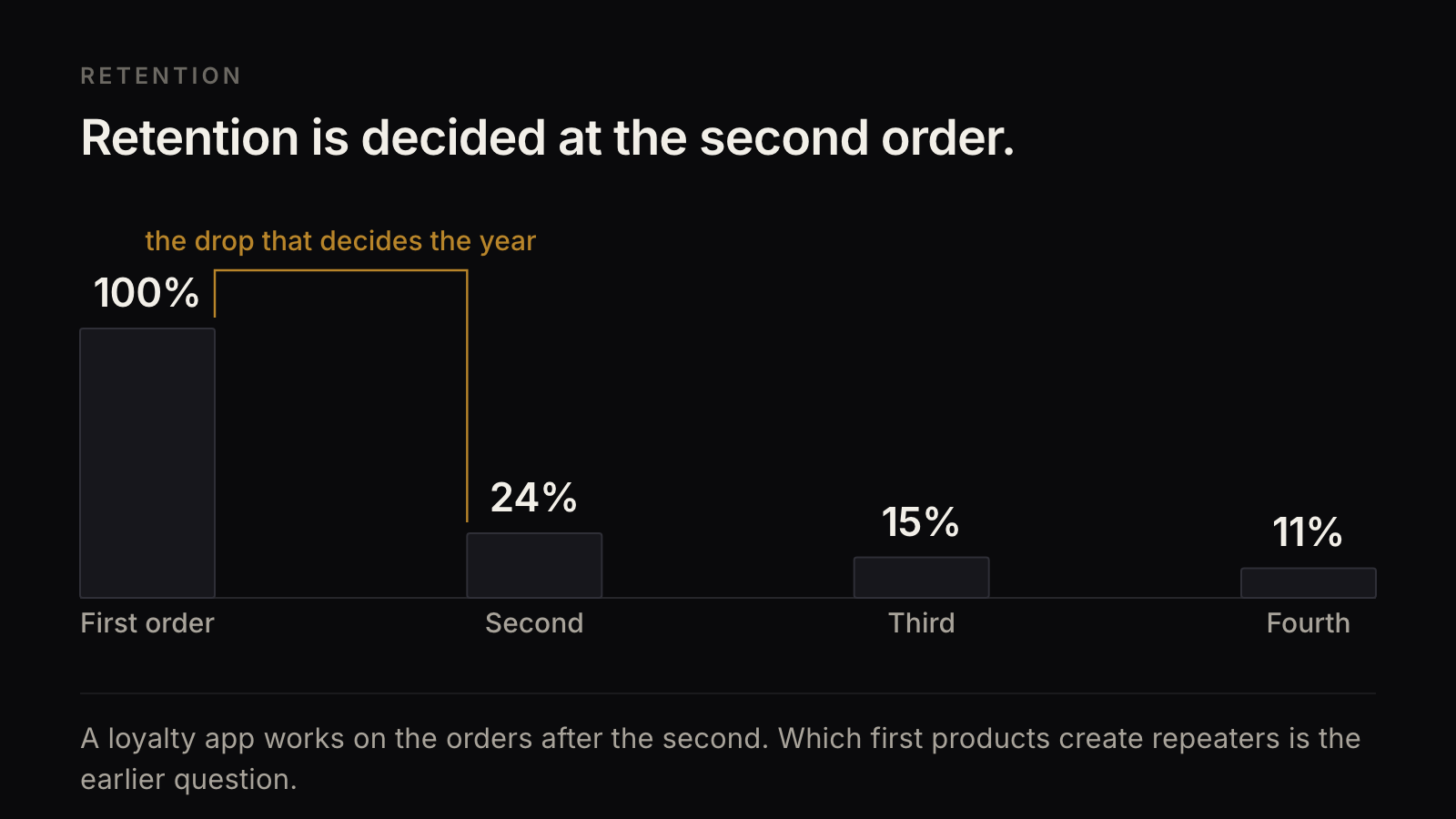
Retention starts before the welcome series. It starts at the SKU that made them a customer.
If last quarter you bought traffic against a sale colourway, a kit with a deluxe sample, or a one-occasion dress, the repeat rate will look like a loyalty problem. The range did the work. Ecommerce merchandising is the sibling when the first product is a range bet. Unit economics is the sibling when that first order never contributed.
A first hour on the first SKU:
- Export new customers for one quarter. Keep the first product on the row.
- Mark which first products have a second order at a price you can live with.
- Mark which ones only come back on a code.
If step 2 and 3 split cleanly, stop writing email. Change what you acquire against, or change how you talk about “retention” in the meeting.
Fashion second orders are often a different product, not a refill. Beauty second orders are often the same SKU on a clock. Comparing those two store-level rates is how brands decide they are bad at loyalty when they are looking at assortment.
Bucket 2: the second item
If the first products that should repeat still do not, you have a second-item problem.
Then the method is a walk, not a flow builder.
On a phone, as the person who already bought:
- Can they find the refill, the care item, or the next size without a hunt through
/collections/? - Does the post-purchase page push a blanket code before it shows the product that belongs next?
- For beauty, is the empty date honest, or do you only write when you need cash?
- For fashion, is there a second piece that belongs with the first at a margin you can keep?
Fix the step that fails. A win-back mail that restates 20% off will not create a replenishment habit. It will train the next wait.
Do not install three retention apps that all claim the same repeat rate.
Bucket 3: was the discount incremental
The last bucket is the one the ESP skip.
Open a sample of second orders. How many used a code they did not need? How many were a sale that pulled forward a bottle that was going to refill anyway? How many look like a new full-price relationship?
If the incremental slice is thin, you do not have a retention programme. You have a cheaper second invoice and a trained reflex.
Fashion “VIP sale” will lift repeat and train the calendar. Beauty “replenish and save” will lift repeat and hide whether the empty date was enough. Both can be right in a week you need cash. Neither is proof the second order was healthier.
You will not get that read from a flow screenshot. You need orders by first SKU, by the second line, and by the offer that sat on it.
A sequence you can run this week
- Pick one quarter. Name the first-product definition you will hold still.
- Split second orders by first SKU. If the first product explains the rate, write that down and stop.
- If it does not, walk the post-purchase and the three PDPs that should refill or pair. Write the first broken next step.
- Only then look at the codes. Pull a sample of second orders. Mark which ones still look incremental.
A sample of thirty second orders is enough to see a pattern. Mark each one: pulled forward; code they did not need; or a second product at a price you can keep. If most of the sample is the first two, the retention project is a costume.
TwoKai starts with the outcome. Repeaters you can defend on the first products that matter. Then we engineer the route.
What's missing
This article can give you an order of look: first product, then the second item, then whether the discount was incremental. It cannot tell you which of your first SKUs create repeaters, or which codes paid for themselves on your orders. That split lives on your catalogue.
Related: Customer retention in ecommerce · Ecommerce merchandising: what to measure under the word · Unit economics for a Shopify fashion or beauty brand
If you want that investigation led as one commercial piece of work, Explore an opportunity with TwoKai.