Incrementality testing in ecommerce
People type “incrementality testing ecommerce” when the tiles disagree and someone wants a test, not another dashboard argument. A holdout is named. A geo is named. A pause is named. The meeting still has not named the decision the test is allowed to settle.
MER vs ROAS already says incrementality should overrule the loud tile. This page is the sibling. What a test is for. Which class can answer the question you actually have. What “good evidence” looks like before you buy a lift study you cannot act on.
This is not a second measurement essay. That page is literacy. This one is the instrument. Fashion and beauty belong in the examples.
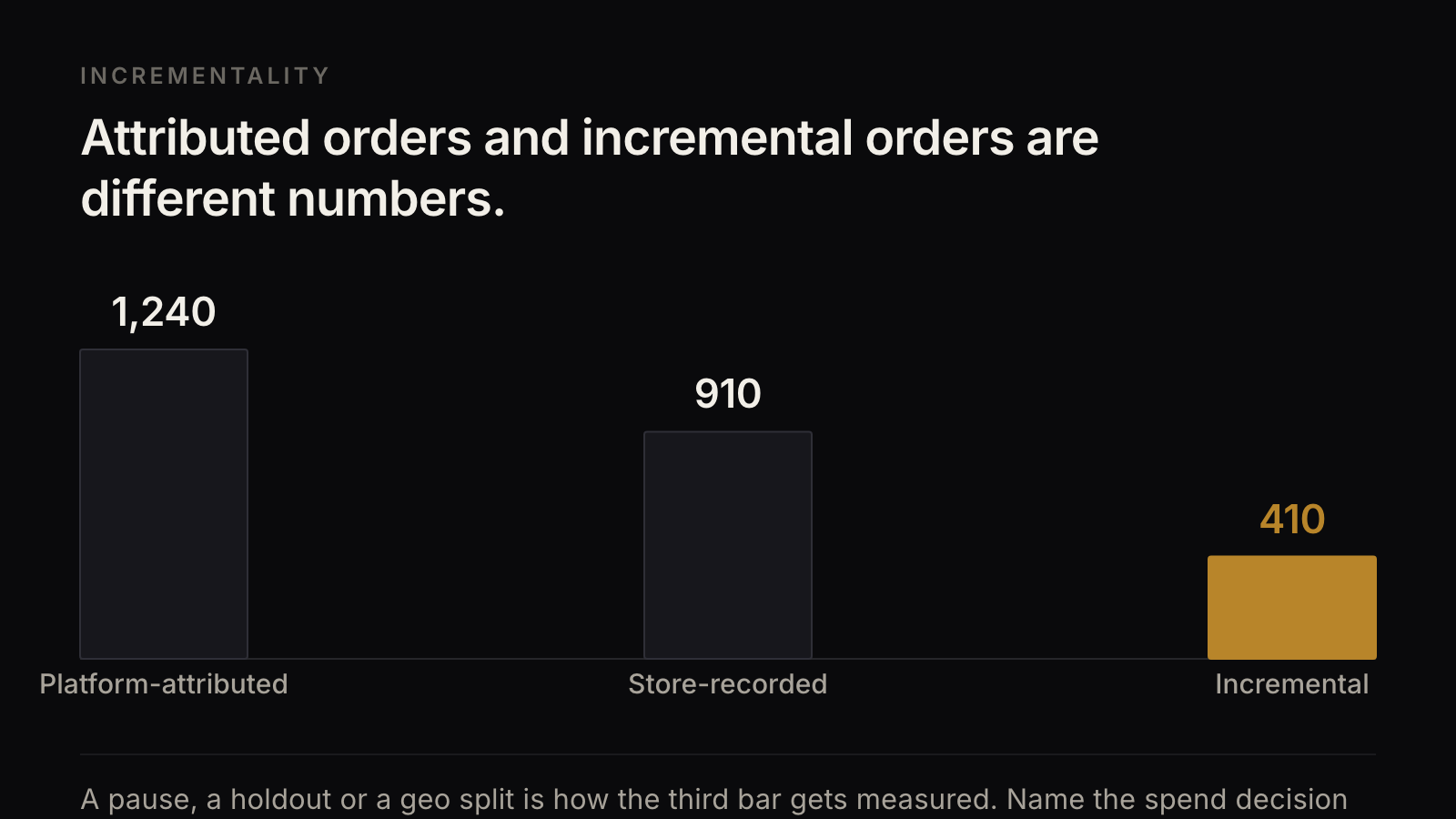
Name the decision first
A test without a decision is a costume. You will run it, argue the method, and spend the same way in week five.
Write the decision in one line before you pick a design.
- Kill or keep this campaign next month.
- Add 20% spend on this first SKU.
- Stop remarketing the sale audience.
- Keep brand search and cut prospecting, or the reverse.
If you cannot write that line, you do not need a test yet. You need the literacy sibling. What is a good ROAS for ecommerce is the judgment page when the fight is 2× vs 4×. Unit economics for a Shopify fashion or beauty brand is the page when the fight is contribution after the order.
Fashion example: “Do we scale paid on /products/linen-shirt in week two of the drop, or is launch ROAS stolen demand?” Beauty example: “Does always-on on the hero serum create first orders, or are we paying for bottles that were already going to replenish?”
Pick a test class that can settle it
Three classes cover most ecommerce spend fights. You do not need all three. You need the one that can move the decision you wrote down.
A pause. Turn the thing off in a window you can survive. Watch orders, not the platform’s remaining credit. Good when the campaign is loud and you can stand a quiet fortnight. Weak when seasonality or a drop calendar will hide the result.
A holdout. Keep a slice of people, geos, or auctions out of the spend. Compare them to the exposed slice. Good when you will keep spending and need a control. Weak when the audience leaks across the line, or the holdout is too small to see a fashion week.
A geo or market split. Spend in some regions. Hold others. Good when creative and offer can stay equal. Weak when the brand is famous in one city and unknown in another, or when delivery and range are not the same.
Do not start with a vendor’s geo-lift deck. Start with whether you can keep the offer, the first SKU, and the measurement window honest. A beauty gift-with-purchase in the test cell and full price in the control is not a spend test. It is an offer test wearing a media hat.
What good evidence looks like
You will not get a court verdict from two weeks of Meta. You can get evidence that is good enough to act.
Good enough usually means four things.
- The decision was written before the result.
- The window is long enough for the first SKU’s clock. A fashion drop and a 28-day serum do not share a week.
- You watched store orders and contribution, not only the platform’s conversion event.
- You can name what would make you stop. A number, a direction, a week you will not extend.
If you cannot name the stop rule, the test will become a story that protects the spend.
A sample you can run without a lab: pick one campaign that looks too cheap. Write the decision. Pause it or hold out one region you can stand to lose. Compare orders on the first SKU, not blended revenue. Mark whether the “lost” orders showed up on branded search, email, or the same PDP from another click.
Thirty orders in the quiet cell is often enough to see a pattern. It is not enough to publish a case study. It is enough to stop scaling a remarketing line that was standing in front of a sale.
TwoKai starts with the outcome. A spend decision you can defend. Then we engineer the route. Sometimes that is a pause you already had the nerve for. Sometimes it is a join between ads, orders, and returns. Sometimes it is leaving the tile alone.
What's missing
This article can give you an order of look: name the decision, pick a test class, say what evidence can settle it. It cannot tell you which of your campaigns is claiming sales it did not cause, or which holdout would be large enough on your catalogue. That split lives on your orders.
Related: MER vs ROAS: which number do you spend against? · What is a good ROAS for ecommerce? · Unit economics for a Shopify fashion or beauty brand
If you want that investigation led as one commercial piece of work, Explore an opportunity with TwoKai.