Ecommerce contribution margin
People type “ecommerce contribution margin” when revenue looks fine and the month does not. Gross looks respectable. AOV is up. Someone still cannot say what an order left after the costs that moved with it.
Unit economics for a Shopify fashion or beauty brand already walks those costs on an order. This page is the sibling. It names contribution margin as the decision number. What belongs in the line. What teams leave out. When revenue, gross, or AOV is the wrong last word.
This is not a textbook formula page. That SERP is finance class. Unbranded ecommerce contribution margin is the operator stem. Fashion and beauty belong in the examples.
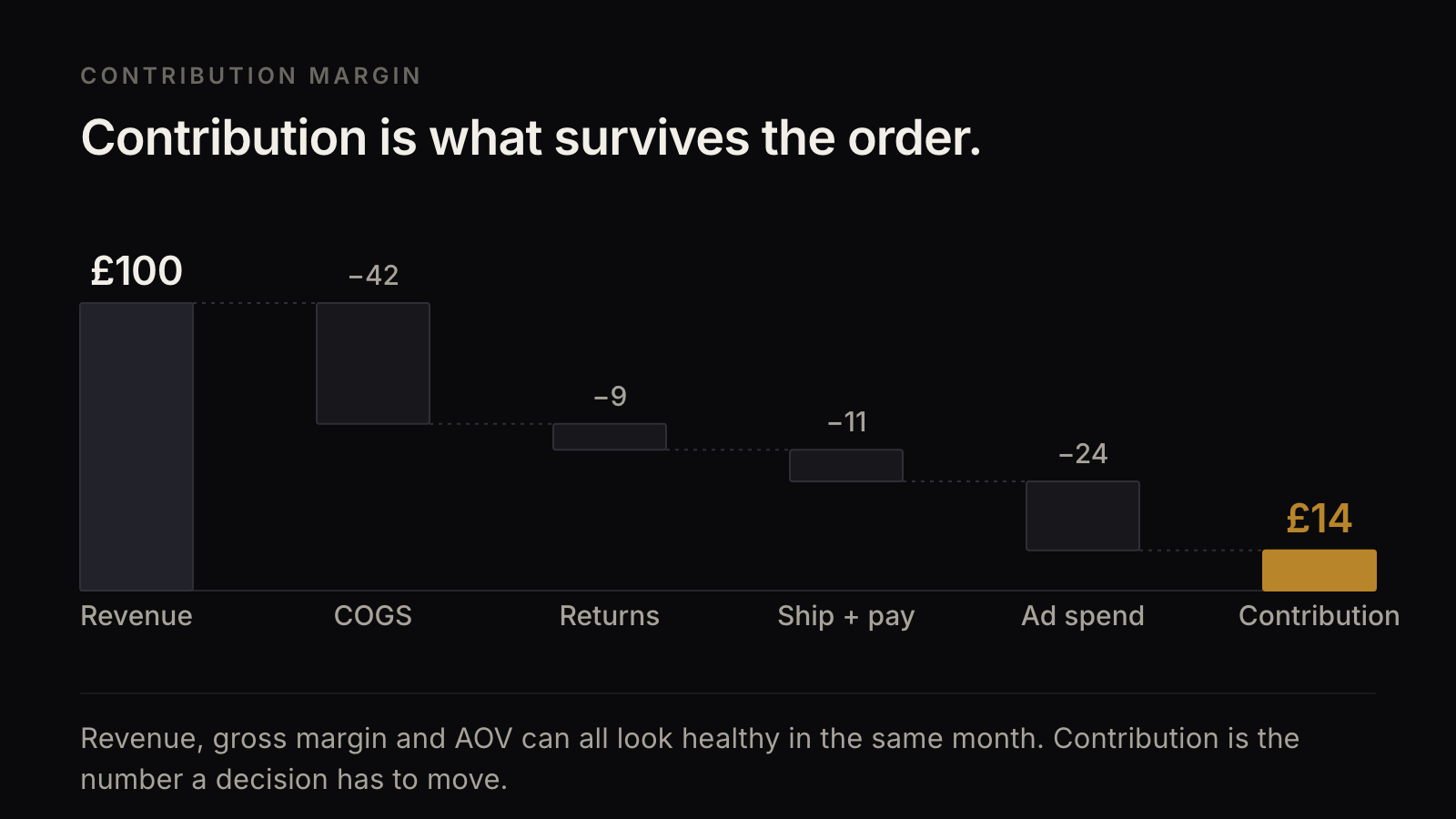
What the decision number is for
Revenue answers “how much came in.” Gross margin answers “what was left after product.” AOV answers “how large was the basket.” Contribution margin answers “what was left after the costs that moved with this order or this customer.”
You spend against contribution when the decision is whether a channel, a first SKU, or a drop is allowed to continue. You spend against revenue when you need a headline. You spend against AOV when an upsell app is in the tab.
How to increase average order value is the how-to sibling when the basket is the tile. This page stays on the line underneath.
A useful operator line, in English:
- start with paid price
- take off product cost
- take off shipping and payment that you do not recover
- take off the expected return
- take off the gift or sample that sat on the order
- take off the ads and variable selling cost you assign to that order
- take off markdown you already know is coming on that unit
What remains is contribution. The percentage is that amount over paid price, or over a customer’s first order, if that is the decision. Pick one and hold it still. Do not switch mid-argument.
You do not need a finance textbook to write that list. You need the costs you actually have.
What people leave out
The leaks are boring and they are where the month goes.
Returns. Fashion size-two and “order both colours” will print revenue and take it back. If return rate is not in the line, contribution is a wish.
Markdown. A drop that looks healthy in week one and sits at 30% off in week six had a markdown clock. If you only cost the unit at full price, you are reading launch week.
Gifts and kits. Beauty gift-with-purchase and a deluxe sample are product cost. They are often booked as marketing so the margin tile stays pretty.
Ads on the first order. What is a good CAC is the judgment page for the acquisition clock. Contribution still has to say whether that first order had anything left after the click.
App and selling tax. The stack that ships every order has a variable cost. Leave it out and every channel looks healthier than the P&L.
Ecommerce merchandising is the sibling when the first product and the markdown clock are a range bet.
Fashion and beauty do not share a good rate. A replenishing serum can carry a weaker first-order contribution if the second order is real. A seasonal jacket cannot borrow that story.
A sequence you can run this week
- Write the decision. Keep this SKU, keep this channel, or keep this drop shape.
- Pick ten orders that match that decision. Reconstruct the line from the list above.
- Mark what you had to guess. Returns, gift COGS, and markdown are the usual holes.
- Compare that read to the revenue and AOV tiles for the same week.
If the tiles look fine and the ten orders do not, the dashboard is not the instrument. The join is the work.
A sample of ten is enough to see a pattern. It is not a year of management accounts. It is enough to stop scaling a kit whose gift ate the line.
TwoKai starts with the outcome. A number you can spend against. Then we engineer the route.
What's missing
This article can name contribution margin as the decision number and list what belongs in the line. It cannot tell you what your orders leave after returns, markdown, gifts, and ads. That reconstruction lives on your catalogue. You can check one typed order at the ROAS calculator.
Related: Is your ROAS target making you money? · Unit economics for a Shopify fashion or beauty brand · What is a good CAC, LTV:CAC, and payback? · Ecommerce merchandising: what to measure under the word · Check break-even on one order
If you want that investigation led as one commercial piece of work, Explore an opportunity with TwoKai.