Is your ROAS target making you money?
The meeting has a number. Four. Or three. Someone put it in the ads manager last quarter and the account has been buying against it since. Spend is up. Sales are flatter than the tile. The question people actually have is narrower than “what is a good ROAS.” They want to know whether this target, on this product, still makes money.
It often does not. The target was set from a margin shortcut, or from a category blog, or from a week when returns had not landed. The shortcut everyone has seen is 1 divided by gross margin. On a 68% margin that prints 1.5. That number ignores VAT sitting in the till price, the units that come back, shipping, and card fees. The real floor on the same order is often nearer 3.
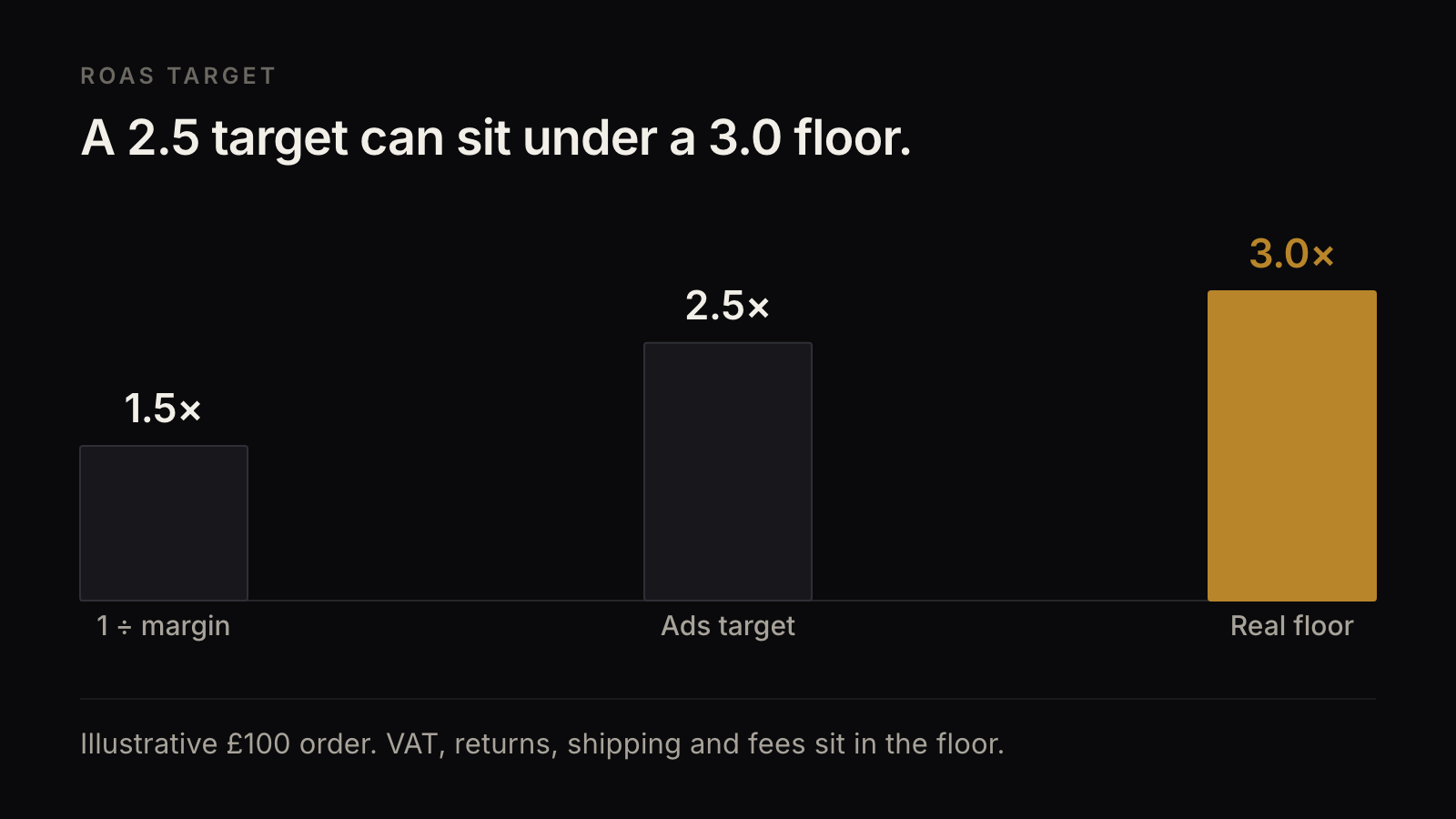
A 2.5 target can look disciplined next to 1.5 and still sit under the floor. Every order the ads buy then loses money. The tile can stay green while the bank account does not.
What is a good ROAS for ecommerce is the judgment page on 2× versus 4×. This page is the check on one typed order.
People type money, not percent
Operators do not walk around with a contribution rate. They know the till price. They know, roughly, what the unit cost to land. They know this product comes back more than the brand average, or less. Those three numbers are enough to start.
Shipping, card fees, VAT or sales tax, and the cost of handling a return all sit in the floor. Leave any of them out and the target you put in the ads manager is too kind. Fashion size returns move the floor more than a moisturiser that stays sold. A 20% code does not make the product cheaper. It makes the same cost sit on a smaller sale.
Half of the same conversation is CPA. Break-even CPA is the same fact as break-even ROAS. If an order keeps £33 before ads, you can pay £33 for the order and still be at zero. A 3.0 ROAS on a £100 sale is that same £33. Pick the unit your team already uses. Do not run two meetings about one number.
There is no universal good ROAS
3× on a £36 beauty kit is not 10× on a £180 jacket. A 2.1 break-even can be a viable first-order bet if the second order is real. It can be fatal on a drop that will be marked down in six weeks. The multiple is a function of the unit, not a badge.
Sell-again products can run below first-order break-even on purpose. That is a bet on the second order. It is not free money. If you cannot name the second-order rate you are defending, you are not making that bet. You are hoping.
Type the till price, the landed cost, and how much comes back. The waterfall is the proof. The floor and the CPA sit under it. The verdict is on the target already in the ads manager, not on a blog average.
What's missing
This is one product and typed numbers. It cannot see returns by size and shade, true landed cost across the PO, or whether the second order is a bet you can defend on live data. That is the work on your order book.
Related: What is a good ROAS for ecommerce? · MER vs ROAS: which number do you spend against? · ROAS vs ROI: which number can approve a budget? · Unit economics for a Shopify fashion or beauty brand · Check break-even on one order
If you want that investigation, Explore an opportunity with TwoKai.