What is a good repeat purchase rate?
People type “what is a good repeat purchase rate” when they bought once and the second order is missing. The file says 18%. Someone wants to know if that is fine. The sale weeks still look like the only weeks anyone comes back.
There is no good store-wide rate. Beauty replenishment and a fashion second item are different jobs. Comparing them is how brands conclude they are “bad at loyalty” when they are looking at first products.
Customer retention in ecommerce already opens on sale-only behaviour. How to improve customer retention is the how-to sibling. This page is the judgment. What the rate counts. Why a range is not a verdict. What a good number hides.
This is not a loyalty-app tips page.
What the rate counts
Repeat purchase rate is customers with a second paid order, over customers who had a first paid order, in a window you can defend. Teams quietly change the window and the definition of “customer.”
Write the fraction down.
- numerator: a second paid order, or a second session, or a second email click
- denominator: first-time customers in the cohort, or the whole file
- window: 90 days, 180 days, or “ever”
“Ever” will flatter a brand that has been live for five years and starve a brand that launched last spring. 90 days is more honest for many fashion and beauty first products. It is still a choice. Hold it still.
A sale-only second order is the usual hole. If order two only happens at 30% off, you did not retain a customer. You retained a deal. When discounts destroy margin is the sibling on the offer.
Exchanges and store credit can inflate the numerator. A fit send-back that becomes a different size is not a second purchase. It is the first purchase finishing.
Beauty empty date versus fashion second item
A replenishing serum has a clock. A “good” repeat rate on that hero can sit well above the store. The customer ran out. You met a physical fact.
A fashion occasion piece has to earn a different basket. A “good” rate on that first SKU can sit low and still be honest. The leak may be the next drop, not a points programme.
Do not put those two in one benchmark slide. Cut by first SKU. The hero that empties and the jacket will not share a good rate.
Subscription ecommerce is the sibling when someone wants a billing product to stand in for the clock.
What a good rate cannot settle
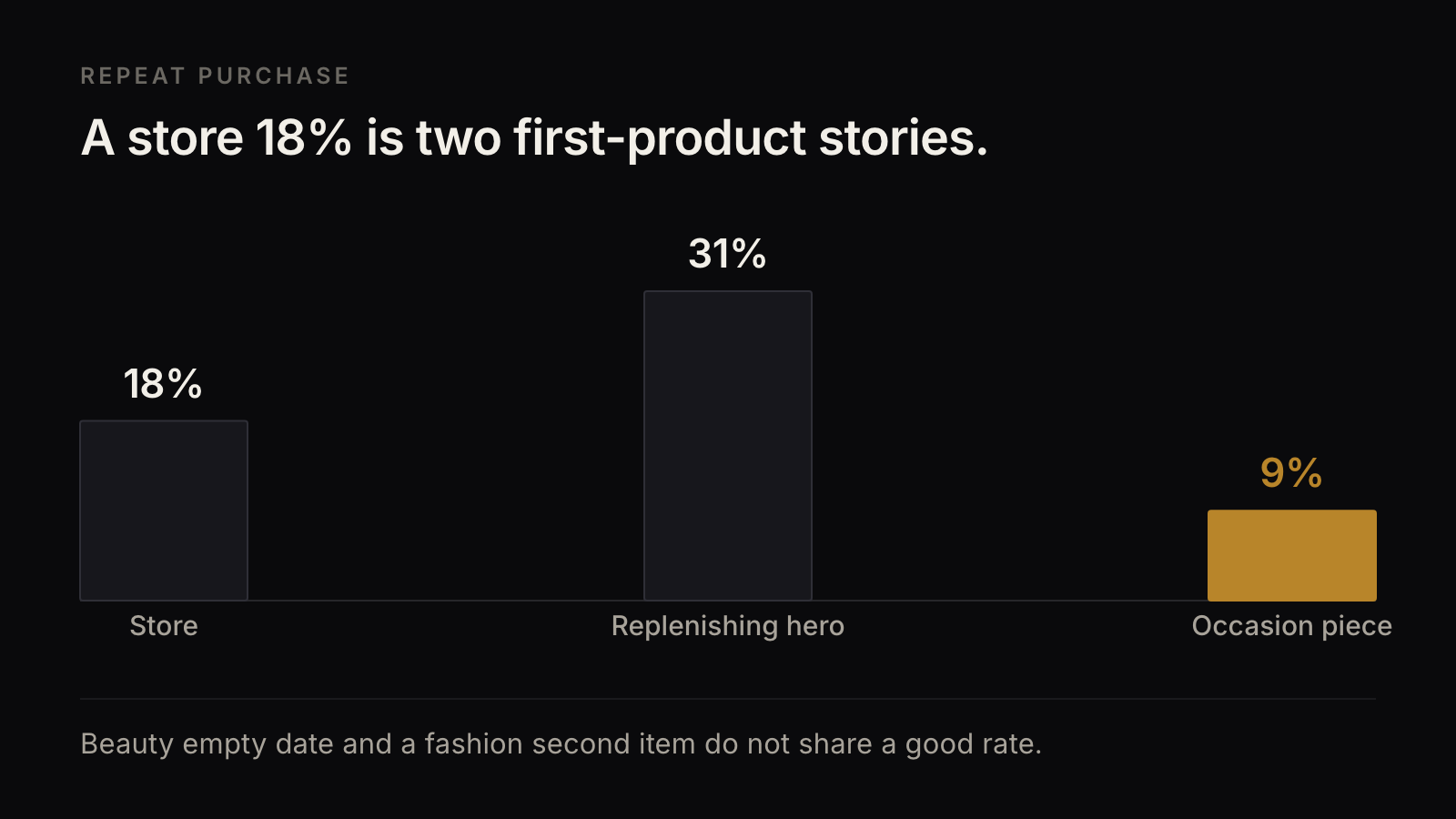
The rate cannot tell you which first products create repeaters. A store 18% can be 31% on one hero and 9% on the rest. The store number will send you to an ESP. The split sends you to the buy.
It cannot tell you whether the second order had contribution. What is a good CAC, LTV:CAC, and payback? is the clock. Repeat rate is only the count.
It cannot tell you whether paid is buying one-time deal hunters. Blended CAC is the measurement sibling when the average hides the mix.
Do not brief a loyalty programme off the store target. Cut the cohort by first SKU and by whether order two was full price.
What “good” hides
A store 18% can be a replenishing hero doing the work and a long tail that never comes back. The meeting will still ask for a points programme.
Fashion hides the next drop inside the rate. If order two is the following colourway at full price, the rate is an assortment win. If order two is the same SKU at 30% off, the rate is a sale file.
Beauty hides the empty date. If order two lands when the bottle is empty, the rate is a physical fact. If it only lands inside a subscribe discount, the rate is a price.
Cohort analysis in ecommerce is the method sibling when you need to see which first-order month produced the count. This page only judges the percentage.
Do not write a loyalty-app tips page on the back of a store target. Points will not invent an empty date. They will not invent a second fashion item.
When the second order is still a customer
Count a second paid order. Do not count an exchange. Do not count store credit that finishes the first basket.
Prefer a 90-day window for a first read. Fashion drops and beauty empty dates both fit that clock often enough to compare SKUs. Then hold it still.
A sale-only second order can stay in a separate column. You may still want those people. You should not call them retained at full contribution.
What is a good churn rate for ecommerce? is the sibling when someone imported a SaaS tile. Repeat rate is the count. Churn is often a mistranslation of never-second.
A sequence you can run this week
You do not need a CDP for a first read. You need one first-order month.
- Write the fraction. Second paid order. 90 days. First-time buyers last quarter. Hold it.
- Split those buyers by first SKU. Rank the SKUs.
- Mark which second orders used a sitewide code.
- Reconstruct contribution on a sample of ten second orders, with the code in the line.
If two first SKUs create most of the repeaters, you do not have a retention problem. You have a first-product story you are not buying enough of, or a long tail you should stop acquiring.
If the sample’s second order is below the line you would accept, the rate was never the win.
TwoKai starts with the outcome. A second order you can defend on the first products that actually come back. Then we engineer the route.
What's missing
This article can say what the rate counts, and why beauty and fashion do not share a good number. It cannot tell you which of your first SKUs create repeaters. That split lives on your orders.
Related: Customer retention in ecommerce · How to improve customer retention · What is a good CAC, LTV:CAC, and payback? · Subscription ecommerce: replenishment is not a billing product · Explore an opportunity with TwoKai
If you want that investigation led as one commercial piece of work, Explore an opportunity with TwoKai.