Subscription ecommerce: replenishment is not a billing product
People type “subscription ecommerce” when they turned on a recurring checkout and contribution did not move. The tile says subscribers. The month still looks like first orders. Someone asks whether they need a better app.
They do not. They need to name the job.
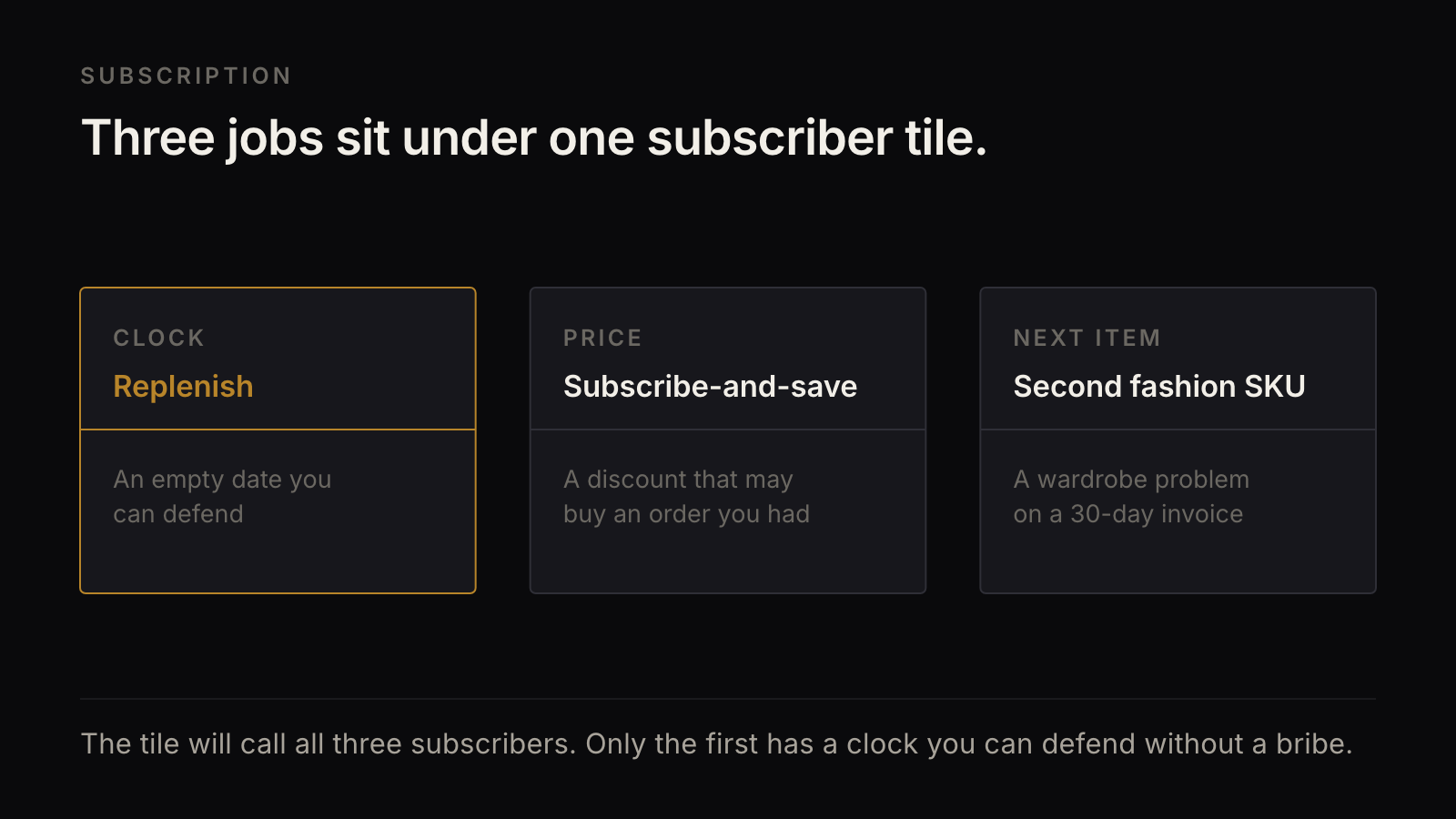
Replenishment, subscribe-and-save, and a second fashion item are three different commercial jobs. A billing product can sit under any of them. It does not choose which one you have. Fashion and beauty make different versions of the same mistake. Beauty often has an empty date. Fashion often has to earn an entirely different basket.
Customer retention in ecommerce already opens on sale-only behaviour. Unit economics for a Shopify fashion or beauty brand walks the costs on an order. This page stays on the offer shape. What a subscription is for. What it is not. When a skip or a cancel is the honest read.
This is not an app list.
Name the job before the app
Replenishment is a product that runs out. A serum, a cleanser, a colour that people finish. The clock is the empty date. If they buy again because the bottle is empty, you did not invent loyalty. You met a physical fact.
Subscribe-and-save is a price on a first order that also locks a future one. The customer may have bought the hero once. You added a discount and a cadence. You may have bought a second order you already owned, at a worse contribution.
A second fashion item is not a refill. The jacket does not empty. The next order is a different SKU, a different drop, or a different reason to dress. Putting that customer on a 30-day cadence is a category error.
The tile will call all three “subscribers.” Only the first has a clock you can defend without a bribe.
When subscribe-and-save eats the second order
Beauty teams reach for subscribe-and-save because the hero can refill. That is real. The leak is the cadence you picked and the discount you left on.
A 20% subscribe offer that fires before the empty date pulls bottles forward. You will call it retention. You bought demand you already had. When discounts destroy margin is the sibling when the offer itself is the question. This page only needs the clock.
Fashion teams copy the same widget onto a drop calendar. The customer subscribed to a t-shirt. The next drop is a coat. The skip rate will look like a retention problem. It is an assortment problem wearing a billing label.
A useful meeting test, said out loud:
- Would this person have bought this SKU on the empty date without the subscribe discount?
- Did we cut first-order contribution below a line we can defend on this product?
- Is the next shipment the same job, or a different wardrobe problem?
If you cannot answer the first question, you do not have a subscription strategy. You have a cheaper first click.
What the skip and cancel rates are for
Skip is not churn. Cancel is not always a lost customer.
A skip on a beauty hero near the empty date can be honest. They still have product. A skip on a fashion drop because the next SKU is wrong is a range miss. Treat those as the same rate and you will brief the wrong fix.
Cancel after one shipment is often a first-order bribe wearing off. Cancel after four shipments on a real empty date is a product or a service miss. What is a good CAC, LTV:CAC, and payback? is the judgment page for the acquisition clock. Subscription still has to say whether order two and three had anything left after the discount you left on.
Do not average skip across the whole file. Cut by first SKU. The hero that empties and the occasion piece will not share a good rate.
What the tile cannot settle
A subscriber count cannot tell you whether the next shipment was incremental. A person who would have refilled on the empty date is not a win you bought. They are a shipment you discounted.
It cannot tell you whether order two still had contribution. A 15% subscribe cut on a beauty hero that already sits near break-even is a first-order leak with a calendar attached. Ecommerce contribution margin is the sibling when the line underneath is the question.
It cannot tell you whether fashion should be on a cadence at all. A drop that needs a different second item will produce skips that look like churn. They are assortment. Ecommerce merchandising is the sibling when the next SKU is the miss.
Do not brief a Recharge rebuild, a Stay rebuild, or any other billing swap off the tile. Name the job first. The app is a pipe.
When the honest move is to stop
Stop the widget on a SKU that has no empty date. A jacket, a bag, an occasion dress. Those customers need a next drop they want. They do not need a 30-day invoice.
Stop the discount if the one-off sample already repeats. You are paying for an order you already owned.
Stop calling skip a retention crisis if the next shipment is a different wardrobe problem. Change the assortment brief. Leave the billing product alone.
Keep the cadence when the empty date is real, the one-off sample is weaker, and contribution on the subscribe sample still clears the line you would accept on a cold first order. That is a replenishment product. It earned the pipe.
TwoKai will not write you an app shortlist. The outcome is a recurring order you can defend, or a stop.
A sequence you can run this week
You do not need a subscription platform rebuild for a first read. You need one hero and the orders under it.
- Pick the SKU you would defend as a subscription. Write why. Empty date, or a different story.
- Pull first orders that used the subscribe offer, and first orders that bought the same SKU once.
- Mark the next 90 days. Second shipment, skip, cancel, or a different full-price SKU.
- Reconstruct contribution on a sample of ten subscribe orders, with the discount in the line.
If the subscribe sample repeats and the one-off sample does not, the clock is real. If both samples look the same, the widget is a price.
If contribution on the subscribe sample is below the line you would accept on a cold first order, the cadence also failed the unit.
How to improve customer retention is the how-to order when the first product and the second item are mixed together. This page only needs the offer shape.
TwoKai starts with the outcome. A recurring order you can defend, or a stop to paying for a tile that ate the first basket. Then we engineer the route.
What's missing
This article can name replenishment, subscribe-and-save, and a second item as three jobs. It cannot tell you whether your first SKU should recur, or sell once and wait. That read lives on your empty dates and your orders.
Related: Customer retention in ecommerce · Unit economics for a Shopify fashion or beauty brand · What is a good CAC, LTV:CAC, and payback? · When discounts destroy margin · Check break-even on one order
If you want that investigation led as one commercial piece of work, Explore an opportunity with TwoKai.