Blended CAC in ecommerce
Blended CAC is total acquisition spend divided by new customers. People type “blended CAC” when channel CAC looks fine and the company still feels expensive to grow. Someone averages paid, a share of brand, and last month’s sale week into one number. The slide looks calm. The first product does not.
What is a good CAC, LTV:CAC, and payback already says blended is not CAC. That page is the judgment on the three numbers together. This page is the sibling. When blended is the right instrument. When channel CAC lies the other way. When a first SKU or a sale audience is doing the damage inside the average.
This is not a medical CAC score. If you arrived from a calcium result, you are on the wrong page. Fashion and beauty belong in the examples.
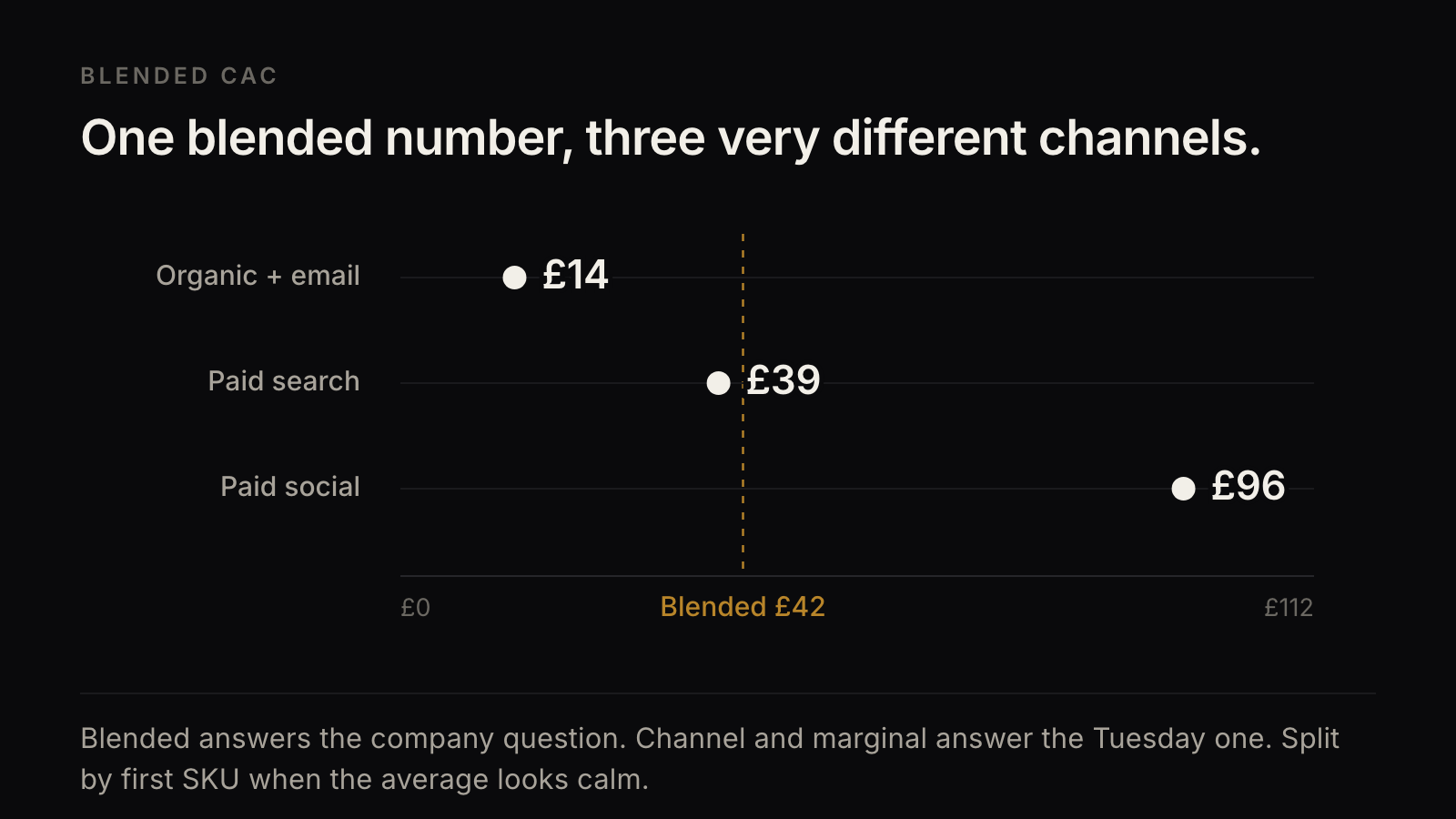
What each number includes
Write the numerator down. Then write who sits in the denominator. Most fights are those two lines.
Channel CAC (or channel CPA dressed as CAC) is spend in one platform, over new customers that platform claimed. Useful for killing an ad set this afternoon. Incomplete for whether acquisition is healthy. The platform will take credit for branded demand and for people who were going to buy the serum anyway.
Blended CAC is usually all acquisition-shaped spend over all new customers in the window. Agency fees and tools belong in the numerator if you still treat them as the cost of getting a first order. Returning purchasers do not belong in the denominator. If they are in it, you are looking at blended efficiency and calling it by the wrong name.
Marginal CAC is what the next slice of spend costs. The extra £10k on Meta against the extra new customers that slice produced. Useful when you are about to scale. Hidden when you only watch the blended year-to-date.
MER vs ROAS is the literacy sibling when the tiles are efficiency, not cost per customer. Unit economics is the page when the first order did not contribute, whatever the CAC label.
When blended hides the leak
Blended is the right instrument when the question is “is the company paying too much to buy customers this quarter?” It is the wrong last word when one channel or one first product is carrying the average.
Fashion example: branded search and a 30% drop week look cheap. Cold paid on a new colourway looks expensive. Blend them and the number looks “fine for fashion.” You will keep buying the colourway. You will call the cheap mix a strategy.
Beauty example: the hero moisturiser repeats. A kit with a deluxe sample does not. Blend new customers and the CAC looks stable. The kit cohort never pays back. Customer retention in ecommerce is the sibling when the second order is the real asset and the first SKU was a discounter.
A first hour on the split:
- Hold the definition still. Same numerator. New customers only.
- Split new customers by channel and by first SKU for the same weeks.
- If one row is cheap because it is branded or on sale, write that down. Do not let it bless the expensive row.
If step 3 explains the quarter, stop decorating the blended tile. Change what you buy, or change the first product you buy against.
When channel CAC lies the other way
Channel CAC can look ugly while the company is fine. You cut the “expensive” prospecting line. Blended gets worse because you starved future demand and kept the remarketing that was standing in front of email.
Channel CAC can look handsome while the company is not. Retargeting the sale audience, brand terms, and a replenishing hero will all print a cheap cost per new customer the platform is willing to claim. Incrementality is the missing layer. The incrementality testing sibling is the page for what a test can settle. This page only needs the instrument rule: a cheap claimed CAC is not proof you created a customer.
A sequence you can run this week
- Write the decision. Company cost, channel kill, or scale.
- Build one blended number you will not change mid-argument.
- Split it by channel and first SKU. Mark sale weeks.
- Only then look at marginal. What did the last spend slice actually add?
A sample of the last fifty new customers is enough to see a pattern. Mark each one: branded, sale, cold paid, or a first SKU you would not buy again. If most of the “cheap CAC” is the first two, the blended story is a costume.
TwoKai starts with the outcome. A cost to acquire you can defend on the first products that matter. Then we engineer the route.
What's missing
This article can tell you when blended, channel, and marginal CAC are the right instrument, and when an average hides a first SKU or a sale channel. It cannot tell you which of your rows is doing that work, or what payback looks like after returns on your catalogue. That split lives on your orders.
Related: What is a good CAC, LTV:CAC, and payback? · Unit economics for a Shopify fashion or beauty brand · MER vs ROAS: which number do you spend against?
If you want that investigation led as one commercial piece of work, Explore an opportunity with TwoKai.