What is a good churn rate for ecommerce?
People type “what is a good churn rate for ecommerce” when the file says churn and the category is replenishment. A dashboard imported a SaaS tile. Someone asks if 6% a month is fine.
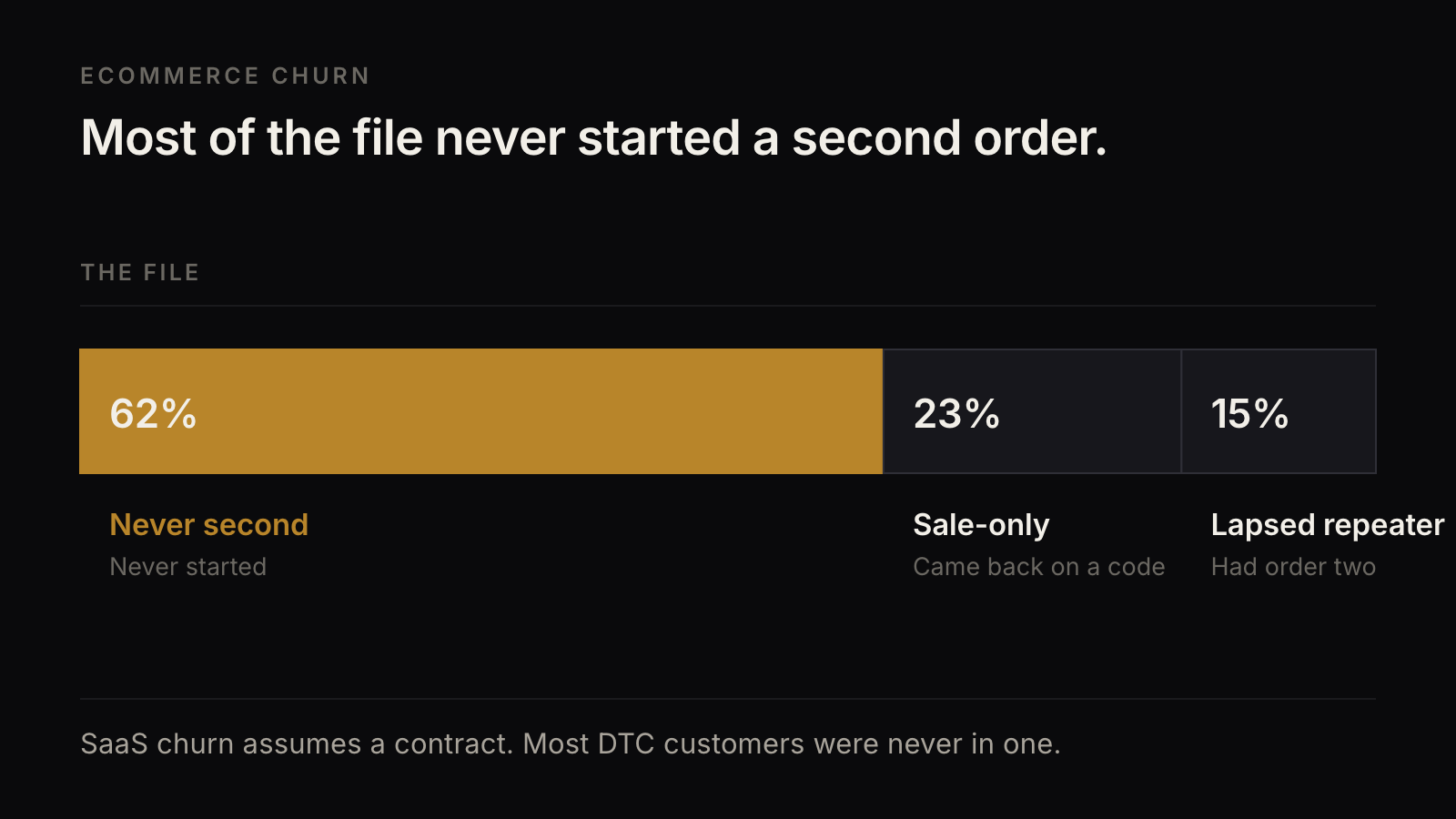
Ecommerce churn is often the wrong instrument. Most fashion and beauty customers are not on a contract. They bought once. They did not leave. They never started a second order. Calling that churn sends you to a win-back flow for a relationship you did not have.
Keep the slug ecommerce-qualified. Bare “churn rate” is HR and SaaS. This page stays on the store. What teams mean. When the word is useful. When it is a mistranslation of repeat.
Customer retention in ecommerce already opens on sale-only behaviour. What is a good repeat purchase rate? is the judgment sibling for the count. This page is the word itself.
What people put in the rate
SaaS churn is customers who cancelled a contract, over customers who had one. Ecommerce teams copy the shape onto a list.
Write what you actually have.
- a subscriber who cancelled a shipment
- a buyer who has not ordered in 180 days
- a buyer who never ordered a second time
- an email that unsubscribed
Those are four jobs. One tile will call them all churn.
Subscription ecommerce is the sibling when the person was on a cadence. Cancel after one shipment is often a first-order bribe wearing off. Cancel after four on a real empty date is a product miss.
A 180-day quiet buyer on a fashion occasion piece may not be churn. They may be waiting for the next drop that fits. A 180-day quiet buyer on a serum that empties in eight weeks is a missed refill.
When the SaaS tile misleads
A monthly churn percentage assumes a base that was alive last month. Most DTC files are a pile of first orders. The denominator is not a subscription book. It is everyone you ever acquired.
That percentage will look “good” if you keep buying new first orders. It will look “bad” if you stop paid for a month. Neither read tells you whether the first product creates a second order.
Beauty teams feel this when they import a retention suite. Fashion teams feel it when a consultant presents a logo-slide from a software company.
Use churn when you have a real cadence and a real cancel. Use repeat purchase rate when you have a first order and a question about order two. Use lapsed-repeater when you had a second order and then silence.
Do not brief a win-back campaign off a SaaS tile. Cut the file into never-second, sale-only second, and true lapsed. The large slice is usually the first one.
What a good rate cannot settle
There is no good ecommerce churn number that is independent of the first product and the offer shape.
A “good” cancel rate on a subscribe-and-save hero can sit next to a terrible never-second rate on the rest of the site. The tile will send you to an email flow. The split sends you to the buy.
What is a good CAC, LTV:CAC, and payback? is the clock. Churn is only a word for who left a thing they were in.
Fashion silence versus beauty silence
A fashion buyer who is quiet for 180 days after an occasion piece may be waiting for the next drop that fits. Calling that churn sends a win-back code into a wardrobe problem. The next colourway is the brief.
A beauty buyer who is quiet for 180 days after a serum that empties in eight weeks missed a refill. That silence is closer to a real leave. The empty date was the clock. You did not meet it.
Do not put those two in one monthly percentage. Cut by first SKU. The jacket and the cleanser will not share a good churn rate, because most of the jacket buyers were never in a contract.
Bare “churn rate” is an HR and SaaS SERP. Keep the question ecommerce-qualified. The store is a file of first orders, plus a smaller file of people who came back.
When a win-back is the wrong brief
A win-back flow assumes a relationship that paused. Never-second is a first-product miss. Sale-only second is an offer miss. True lapsed is the only group that matches the email you want to write.
If never-second is the pile, stop the flow. Change what you acquire.
If sale-only is the pile, change the code. When discounts destroy margin is the sibling.
If true lapsed is the pile, then the word churn has a job. Write why they had order two, and what stopped order three. Fashion next drop and beauty empty date are the usual answers.
A useful meeting test: were they in a cadence, did they ever have order two, and was that second order full price. If you cannot answer those three, you do not have a churn rate. You have a borrowed SaaS word.
A sequence you can run this week
You do not need a new retention suite for a first read. You need the file and one definition.
- Write the definition. Cancel, never-second, or lapsed-repeater. Hold it.
- Count last quarter’s first-time buyers who had no second paid order in 90 days.
- Count subscribers who cancelled after one shipment, and after four.
- Reconstruct contribution on a sample of ten from the never-second group.
If never-second is the pile, stop saying churn. Start saying first product.
If one-shipment cancels dominate, the subscribe discount is the meeting.
TwoKai starts with the outcome. A word that matches the job, and a first-product story you can keep. Then we engineer the route.
What's missing
This article can separate churn from never a second order, and say why the SaaS tile is the wrong instrument. It cannot tell you whether you lost a repeater or never had a second order. That split lives on your file.
Related: Customer retention in ecommerce · What is a good repeat purchase rate? · Subscription ecommerce: replenishment is not a billing product · How to improve customer retention · Explore an opportunity with TwoKai
If you want that investigation led as one commercial piece of work, Explore an opportunity with TwoKai.