What is a good markdown rate?
People type “what is a good markdown rate” when the sale week looked alive and the range is still heavy. Full-price weeks are quiet. Someone wants a number they can put in a board pack.
There is no store-wide good rate. Fashion sits higher than beauty because the product dies on a calendar. A serum does not. Comparing those two percentages is how brands conclude they are “bad at full price” when they are looking at two jobs.
Ecommerce merchandising is the sibling when the word is the range. What is a good sell-through rate is the judgment page for how much moved. This page stays on the discount you took to move it. What the rate counts. Why the average lies. What a good number cannot settle.
This is not a table of stolen industry averages.
What the rate counts
Markdown rate is discount money, or units sold below full price, over the sales you are judging, in a window you can defend. Teams switch those choices and then fight about the percentage.
Write the fraction down.
- numerator: pounds given away, or units that left at a cut
- denominator: full-price sales, or all sales, or the buy
- window: the drop, the month, or the season
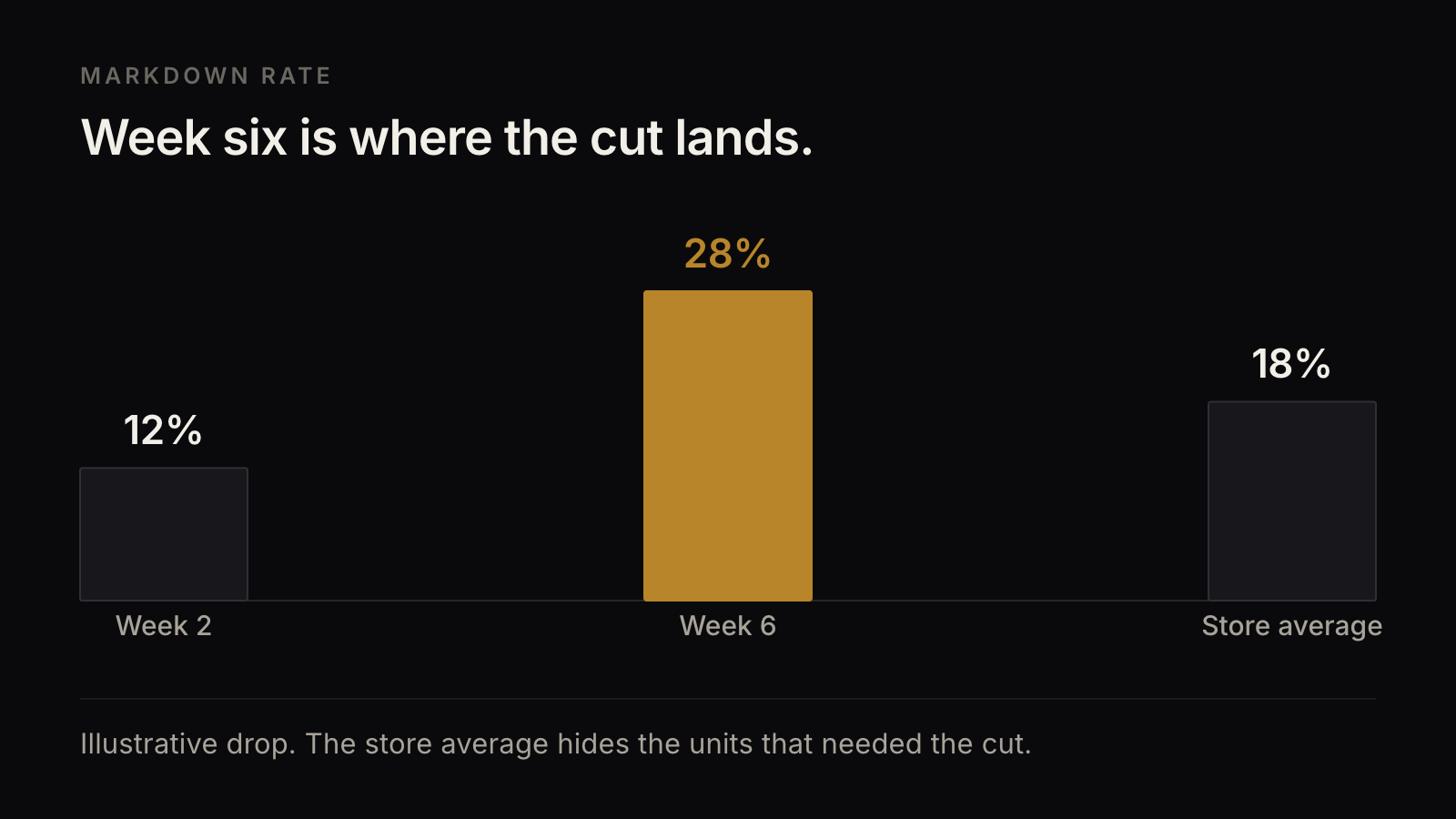
A fashion colourway that launches clean and sits at 30% off in week six had a clock. If you only read launch week, the rate looks healthy. If you only read the season, one hero can hide a dog.
Beauty kits and gift-with-purchase are the usual hole. A “free” deluxe is markdown wearing a marketing hat. If you book it as acquisition, the rate stays pretty and contribution does not.
When discounts destroy margin is the sibling when the offer itself is the question. This page only needs the rate on the range.
Why fashion and beauty do not share a number
Fashion has a drop, a weather window, and a next buy that is already committed. Some markdown is the cost of being wrong about colour or depth. A “good” fashion rate can still be a missed first buy. It can also be the honest remainder of a trend that moved.
Beauty has an empty date. A hero that needs 25% off to refill is a different meeting. You are not clearing a season. You are training a price.
Do not put those two in one benchmark slide. Cut by first product. The jacket and the cleanser will not share a good rate.
Ecommerce contribution margin is the sibling when the question is what the cut left on the order.
What a good rate cannot settle
A board number will not tell you whether your first products are the ones on sale.
A 15% store rate can be 4% on the hero and 45% on last season’s depth. The store number will send you to a promo calendar. The split sends you to the buy.
The rate also cannot tell you whether the cut created demand or pulled it forward. A week that looks alive and a quiet week after is the read. The percentage alone is a mood.
Do not brief next season’s open-to-buy off the store average. Cut by drop and by first SKU. Hold the fraction still.
Open to buy and demand forecasting is the sibling when the next buy is already the argument.
Launch week is not the season
A drop that launches clean in week two can still be a markdown story by week six. The board pack will quote the launch. The cash is in the later weeks.
Fashion colour and depth decide that clock before the first sale. If you bought two extra weeks of a colour the window did not want, the rate is a receipt. It is not a promo talent problem.
Beauty looks quieter because the hero can refill. The leak is the kit and the gift. A “launch set” that only moves at 20% off is training a price. The next empty date will wait for the same cut.
What is a good sell-through rate tells you how much moved. Markdown rate tells you what you paid to move the rest. Read them on the same drop. A healthy sell-through bought with a deep cut is still a buy miss.
Do not steal an industry table and put it in the pack as the product. Those tables mix seasons, channels, and categories you do not have.
What the cut trains
A week that looks alive and a quiet week after is pull-forward. You did not create demand. You moved it.
Fashion customers learn the calendar. If the same colourway hits 30% off every drop, full price becomes a waiting room.
Beauty customers learn the kit. If the hero is cheap only inside a gift set, the empty date waits for the set.
When discounts destroy margin is the sibling when the code is the question. This page only needs the range. The training still sits in the rate.
A sequence you can run on one drop
You do not need a new planning system for a first read. You need one drop and the SKUs that sat.
- Write the fraction. Pounds or units. Drop or month. Hold it.
- Rank the ten SKUs that took the most markdown money.
- Reconstruct contribution on a sample of ten of those orders, with the cut in the line.
- Read the two quiet weeks after the first deep cut. Mark what still moved at full price.
If three SKUs are most of the money, you do not have a markdown culture. You have a buy miss on those three.
If contribution on the sample is below the line you would accept on a cold first order, paid on those SKUs is also the leak.
TwoKai starts with the outcome. A cut you can defend on the units that actually needed it. Then we engineer the route.
What's missing
This article can say what the rate counts, and why fashion sits higher than beauty. It cannot tell you your weeks-on-hand by first product, or whether the last sale created orders. That read lives on your drop.
Related: What is a good sell-through rate? · Ecommerce merchandising: what to measure under the word · When discounts destroy margin · Ecommerce contribution margin · Check break-even on one order
If you want that investigation led as one commercial piece of work, Explore an opportunity with TwoKai.