Weeks of supply: what the cover actually commits
People type “weeks of supply” when cover looks fine and cash is still in the stock. The file says twelve weeks. The hero is thin. Last season is fat. Someone asks for a good number.
Cover is a commitment. It is not a forecast that came true. Fashion and beauty make different versions of the same lie. A drop has a window. A serum has an empty date. A store average will mix them and then look healthy.
Open to buy and demand forecasting is the sibling when the next buy is the argument. Assortment planning for ecommerce is how a range plan is built. This page stays on the cover you are already sitting on. What the number counts. What it commits. What it cannot lock.
This is not an APICS definition page.
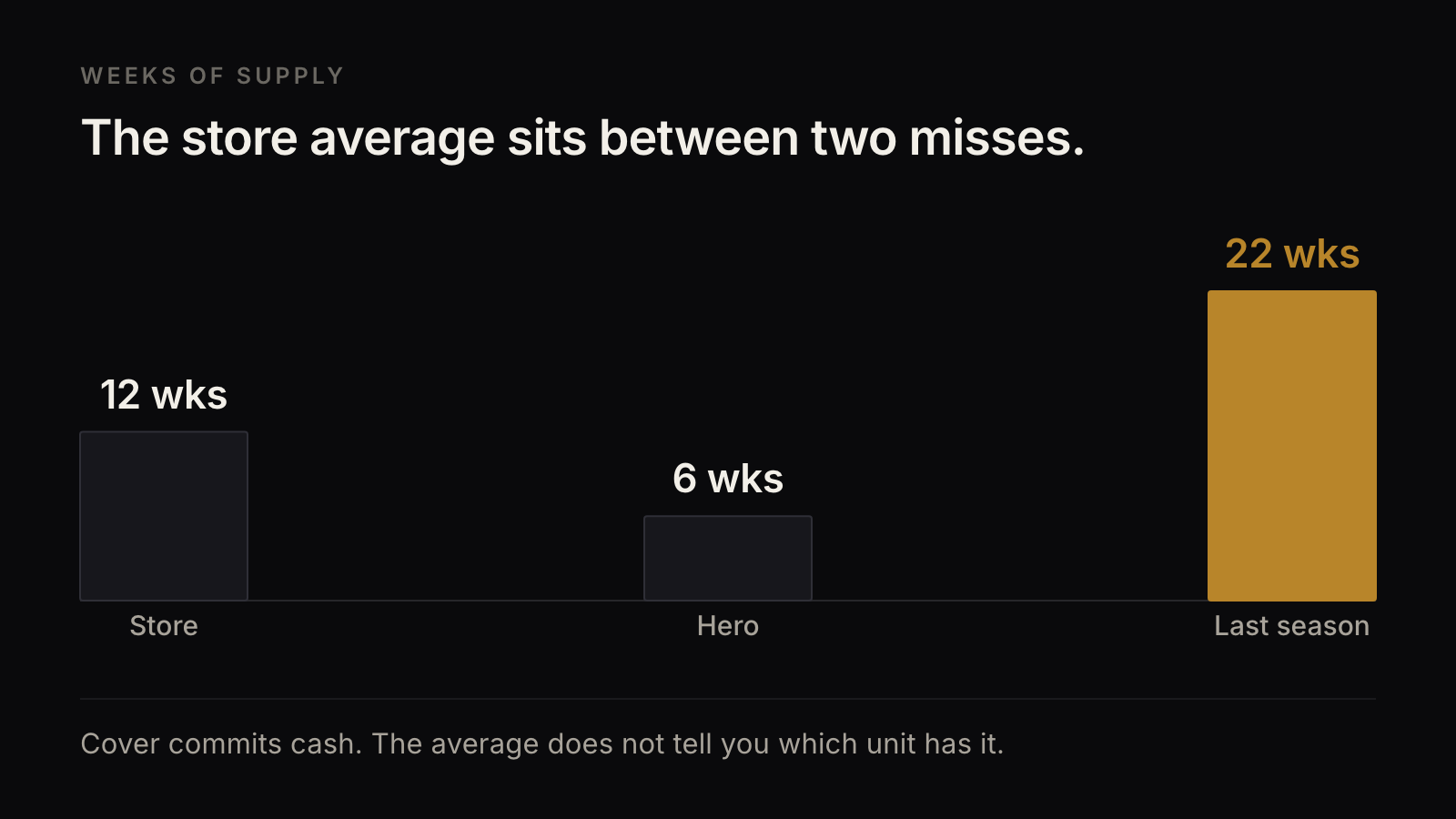
What the number counts
Weeks of supply is units on hand, or weeks of cover at a sell rate you choose, over the rate you are using as “a week.” Teams switch the sell rate and then fight about the weeks.
Write the fraction down.
- numerator: units here, or units on order, or both
- denominator: last four weeks of sales, last twelve, or the plan
- grain: store, first product, or size
A fashion colourway that sold hard in week one and then stopped will look short if you use launch week as the rate, and long if you use the season. Both can be honest. They are different decisions.
Beauty that replenishes will look long if you include a one-off kit in the rate, and short if you only watch the hero. The empty date is the clock. The weeks number is a translation.
On-order stock is the usual hole. If inbound is not in the numerator, you will reorder a hero that is already on a boat. If inbound is in and the boat slips, you will look covered and still miss the window.
What cover commits
Cover commits cash. It commits warehouse space. It commits the next markdown if the rate you used was a hope.
A “healthy” twelve weeks on the store can be six weeks on the size that sells and twenty-two weeks on the size that does not. You are not covered. You are long the wrong unit.
Fashion markdown is how that lie gets paid. What is a good markdown rate? is the judgment page for the cut. Weeks of supply is the clock that made the cut inevitable.
Beauty dead stock is quieter. A shade that does not empty still took the open-to-buy. The hero then stocks out and you buy ads for a 404.
Ecommerce stockouts is the sibling when paid demand met empty cover.
What the number cannot lock
Cover cannot lock demand. A plan that assumed last year’s week-one rate will look precise and still be wrong. The number is a bet you already placed.
It also cannot tell you whether the next buy should exist. A SKU with eight weeks of cover and no second order is not a replenishment story. It is a first-product miss wearing an inventory label.
Do not brief the next drop off the store weeks. Cut by first SKU and by size or shade. Hold the sell rate still. Read the last drop, not the file’s average.
SKU rationalisation is the sibling when the question is what to stop buying.
Fashion window versus beauty empty date
Fashion cover has a weather window and a next buy that is already on a boat. Twelve store weeks can be two weeks of the size that sells and twenty of the size that does not. The window will close. The leftover units will take the markdown.
Beauty cover has an empty date. A hero at six weeks can be tight if the shade that sells is already thin. A kit at twenty-two weeks can look like a plan and still be dead stock. The empty date does not care about the store average.
Do not import an APICS definition and stop there. The textbook will tell you how to compute the weeks. It will not tell you which unit has the cash.
What is a good sell-through rate is the sibling when the last drop is the evidence. Weeks of supply is the commitment you are still sitting on.
Why a healthy average traps cash
The file prefers a single number. Twelve weeks is easy to say in a meeting. It hides the hero that is about to 404 and the leftover depth that will never leave at full price.
Cash is in the long units. Paid is on the short units. You will buy ads for the short list and then take a cut on the long list. That is not a cover policy. That is two misses averaged into a calm slide.
On-order stock makes the lie worse. A boat that is late still sits in the numerator. You look covered. The PDP is already a waitlist.
Hold the sell rate still. Cut the file. The average is a headline.
A sequence you can run this week
You do not need a new forecasting stack for a first read. You need the units that have the cash.
- Write the fraction. Units on hand. Last four weeks as the rate. Hold it.
- Rank the ten SKUs that hold the most weeks and the ten that hold the least.
- Mark which of the long SKUs still have a live full-price week.
- Reconstruct contribution on a sample of ten recent orders from the short SKUs, and ten from the long ones.
If the short list is the hero and the long list is last season, you do not have a cover policy. You have a buy that already failed.
If the long sample only moves on a cut, the weeks number is a markdown clock.
TwoKai starts with the outcome. Cover you can defend on the units that actually sell. Then we engineer the route.
What's missing
This article can say what cover commits and what it cannot lock. It cannot tell you what your last drop actually sold through. That read lives on your units and your weeks.
Related: Open to buy and demand forecasting · Assortment planning for ecommerce · What is a good sell-through rate? · What is a good markdown rate? · Explore an opportunity with TwoKai
If you want that investigation led as one commercial piece of work, Explore an opportunity with TwoKai.