Assortment planning for ecommerce: how a range plan is built
The range looks full. The season is committed. Contribution is thin. That combination is what sends operators looking for assortment planning.
Ecommerce merchandising names the instruments that sit under the word: range, demand, markdown, size and shade. This page is the sibling on the first one. How a range plan gets built, what it commits you to, and why the plan and realised demand come apart a few weeks in.
The short version is that a range decision is a P&L call. Software records it afterwards.
What a range plan actually commits
An assortment plan is a set of commitments made before anyone has seen the demand it is meant to meet. Three of them cost cash.
Option count. How many distinct choices the customer will see. One style in three colourways counts as three options.
Depth. How many units sit behind each option, and how those units spread across sizes or shades.
Phasing. When each option lands, and how many weeks it gets to sell before the calendar forces a price move.
Multiply those three and you have an intake value. That number is cash, and it is committed long before the season trades. Everything else in assortment planning is an argument about how to split it.
Most brands under about £20m write this plan in a spreadsheet. The spreadsheet is fine. The discipline is usually what is missing.
Option count against depth
Option count and depth compete for the same money. Widen one and the other narrows.
Wide and shallow looks generous on a collection page. It also produces broken size runs by week four, a warehouse full of ones and twos, and a markdown bill on options that never carried enough stock to build any momentum. Every extra option costs a sample, a shoot, a description and a listing before it sells a single unit.
Narrow and deep looks thin on the site and carries the opposite risk. If the bet is wrong you own a lot of units of one thing, and the only lever left is price.
The useful way to hold the trade-off is payback per option. Each option has to earn back its own cost to exist, including the working capital sitting in its units. A brand doing £6m across 900 options is asking each one to carry roughly £6,700 of revenue. Write that number down and the argument about newness changes tone.
Depth is also where size and shade decide the outcome. A beauty launch with seven shades and real depth in the two that sell will beat the same launch bought evenly. A dress bought flat across a size curve that skews will look sold through in the middle and dead at both ends.
Core, newness, and the long tail
Every range splits into three jobs. Name them before you argue about numbers.
Core carry-over. Products that repeat season to season. The black trouser. The hero cleanser. Demand history exists, so the forecast is a read rather than a guess. Core should carry the margin and it should be the easiest part of the range to buy.
Seasonal newness. The reason to come back. Newness earns full-price sell-through and it earns editorial and paid attention. It also carries the markdown risk, because you are buying against demand nobody has seen.
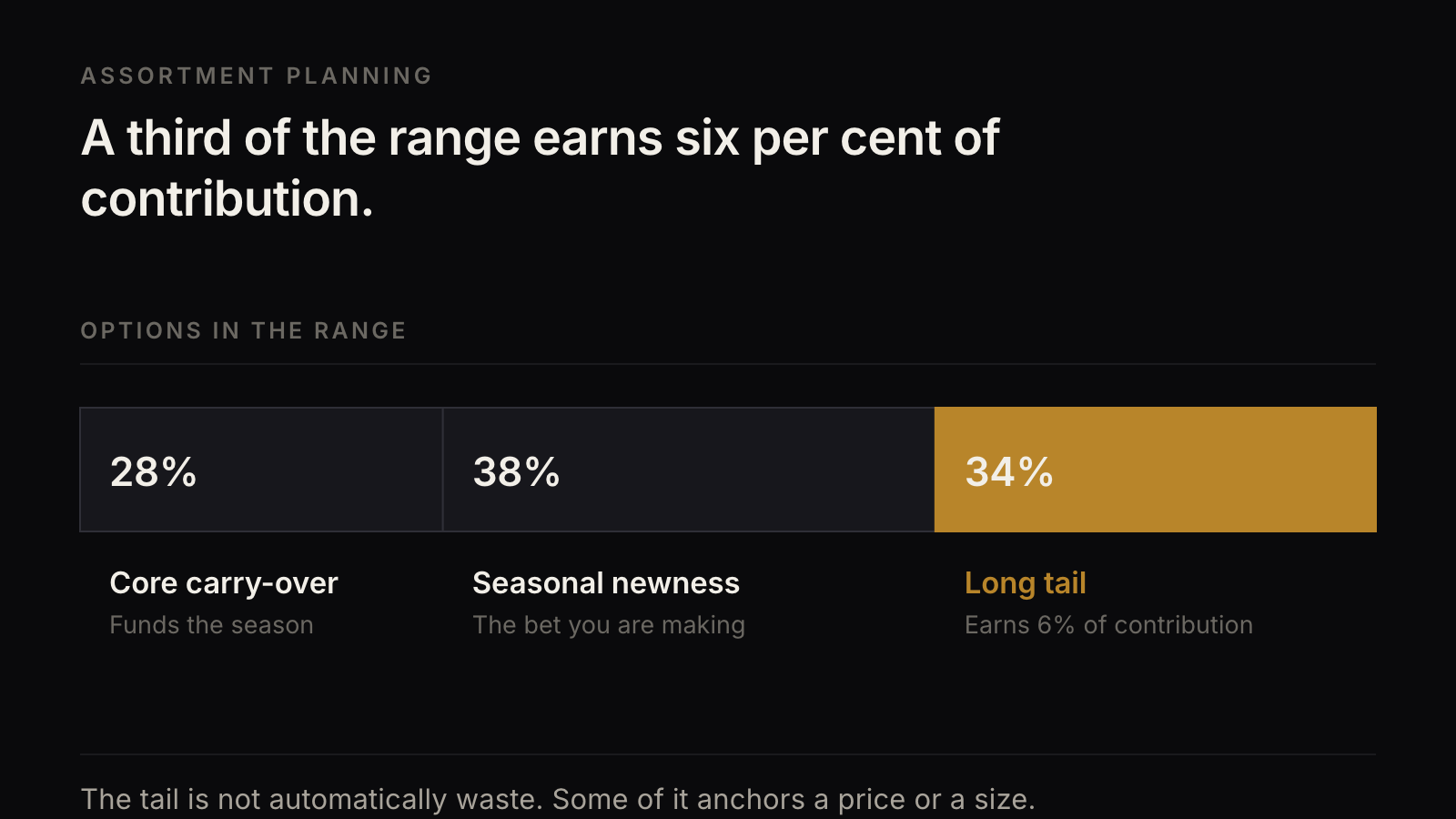
The long tail. Options that exist for a reason nobody writes down. A colourway a wholesale account asked for. A size extension from two years ago. A gift set built for one Christmas. The tail rarely gets cut, because cutting it is somebody's decision and keeping it is nobody's.
SKU rationalisation is the decision about which options to keep and which to stop buying.
The split matters more than the labels. In the figure above, about a third of the range sits in the tail and earns six per cent of contribution. That shape is common and it is survivable, right up to the point where the tail is funded by cash that core needed for depth.
Write the three shares down for your last season, once by option count and once by contribution. If the two orders disagree, you have found the conversation. Ecommerce contribution margin is the page on what belongs in that line.
Why the plan and demand stop agreeing
A range plan is accurate for about three weeks. Then the gap opens, and it helps to know which gap you are looking at.
The forecast was a shape rather than a number. Plans get built on last year, plus a growth factor, plus a view on newness. That produces a total that is often close and a mix that is often wrong.
Full-price weeks were shorter than planned. A competitor discounts in week five. The promotional calendar moves forward. Half the season then trades at a lower price than the plan assumed.
Paid demand flattered the launch. Spend can fill a collection for three weeks and make a slow option look like a winner. When the spend moves on, the option sits.
The curve was wrong even where the option worked. Total units look fine. Saleable units do not, because the middle sizes or the two popular shades went first.
The mistake is treating that gap as a planning failure to fix next season. Every season has a gap. The work is noticing it in week four instead of week ten, and having a repeat buy, a phasing change or a price decision ready to run. When discounts destroy margin is the page on what it costs to find out late.
What the enterprise planning tools are for
Search this topic and o9, RELEX and Oracle Retail arrive quickly. They are serious systems and they solve a real problem. It is not usually your problem yet.
Those platforms exist for scale and coordination. Hundreds of stores. Multiple channels and countries. Allocation and replenishment running every week. Buying teams of twenty people who need one version of the plan. Lead times long enough that a demand signal has to move through a supply chain without anyone typing it in. The value sits in the coordination.
A single-channel brand with one warehouse and three people in the buying meeting has a decision problem instead. The plan already fits on one screen. What is missing is a clean read of sell-through and contribution at option level, and a weekly habit of looking at it.
Buy the platform before you have that read and you get a well-governed version of the same argument. The demo will look like progress. Implementation will take two seasons, and the tool will ask you for master data you do not have.
The range decision is a P&L call
Range gets framed as merchandising taste or as a software gap. It is neither. Every option you commit to moves four lines you already report.
- Gross margin, through the price you can hold and the depth you bought
- Markdown, through the options that needed clearing and how late you noticed
- Working capital, through intake committed months before the season trades
- Cost to serve, through returns on options with a weak size or shade fit
That is the language the decision belongs in. "Should we carry 900 options or 600?" has no answer. "Which 300 options earned less contribution than they cost to exist, and what happens to basket size if they go?" has an answer, and it is on your own orders. Unit economics for a Shopify fashion or beauty brand is the sibling on getting those four lines per order.
A sequence you can run this week
- Export last season at option level. Units, revenue, discount taken, returns, and cost of goods.
- Tag every option core, newness, or tail. Do it fast and do not negotiate with yourself.
- Calculate contribution per option. Revenue after discount, minus cost of goods, minus returns, minus fulfilment.
- Sort by contribution and count the options in each third. Compare the share of options with the share of contribution.
- Take the bottom third and write down why each option exists. Entry price. Size anchor. Gift. Wholesale request. Nobody remembers.
- For your top ten options, check whether you ran out of the middle sizes or the popular shades before the season ended. That is next season's depth conversation.
One season and one afternoon is enough to see the shape. You are not writing the next plan yet. You are finding out whether your range and your contribution point in the same direction.
TwoKai starts with the outcome. A range you can defend on contribution. Then we engineer the route.
What's missing
This page can tell you how a range plan is built, how option count trades against depth, why the plan and realised demand come apart, and what the enterprise planning platforms are actually for. It cannot tell you your own sell-through and contribution at option level, which drop is carrying the season, or which tail options are quietly holding your basket size up. Those three live in your orders and your intake plan.
Related: Ecommerce merchandising: what to measure under the word · Ecommerce contribution margin · When discounts destroy margin
If you want that read built on your own seasons, Explore an opportunity with TwoKai.