What is a good average order value?
People type “what is a good average order value” when AOV is up and contribution is not. The tile looks healthy. The month does not. Someone wants a number they can aim the upsell app at.
There is no good AOV that is independent of the first product. A beauty hero at £28 and a fashion basket at £140 are different businesses. Comparing them is how brands conclude they are “bad at AOV” when they are looking at assortment.
How to increase average order value is already the how-to sibling. Mix and first SKU, then the basket change, then whether the extra pounds survive. This page is the judgment. What the rate counts. Why a range is not a verdict. What a good number cannot settle.
This is not a second tactics list.
What the rate counts
Average order value is paid value over orders, in a window you can defend. Teams quietly change both.
Write the fraction down.
- numerator: paid price, or paid price after returns, or merchandise only
- denominator: all orders, or orders over a threshold, or first orders only
- window: the week, the month, or the drop
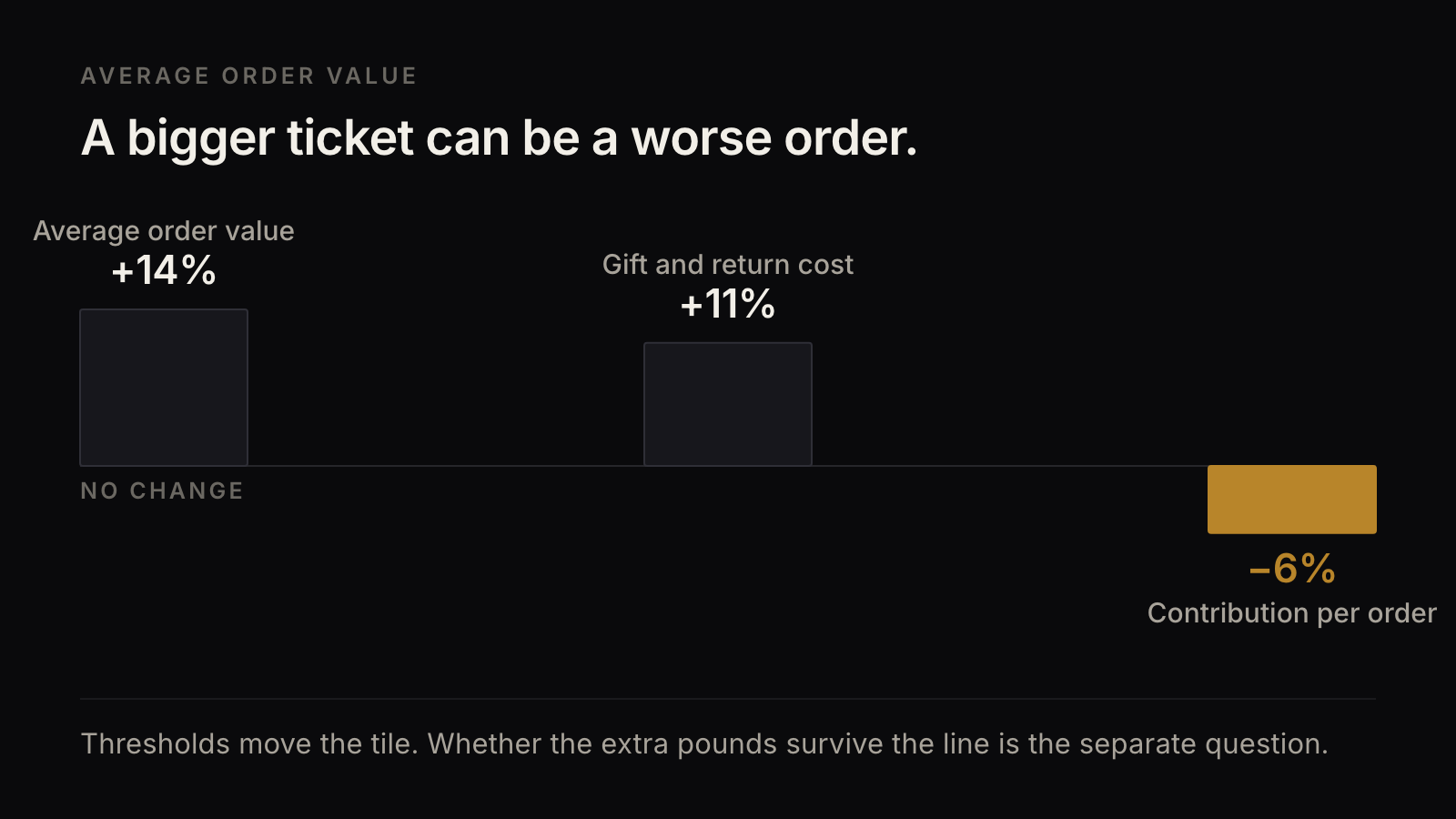
A threshold that moves AOV by excluding the small orders is a reporting trick. The customer still placed those orders. Fashion two-size bets will inflate the numerator and then come back. Beauty gifts will inflate the basket and the COGS.
If you only watch Shopify’s AOV tile, you are watching paid price on captured checkouts. You are not watching contribution. Ecommerce contribution margin is the sibling when the line underneath is the question.
Why a range is not a verdict
People want a fashion number and a beauty number. Those exist as gossip. They do not exist as a spend rule.
A “good” AOV on a replenishing serum can sit well under a jacket programme and still be the right first order. A “good” AOV on a kit that needed a gift and a threshold can be a worse order than the single hero.
Use a range only to refuse the fantasy. Fashion often lives in a wide band because the first product is the basket. Beauty often lives lower because the first product is a trial. Neither band tells you whether your extra item survived markdown, gift cost, and returns.
Unit economics for a Shopify fashion or beauty brand is the page that walks those costs. This page only needs the judgment. The tile is not the verdict.
What a good AOV cannot settle
The rate cannot tell you whether the extra item was incremental. A bundle that would have been two orders is pull-forward wearing an AOV hat.
It cannot tell you whether the extra pounds are still contribution after the gift, the return, and the markdown you already know is coming.
It cannot tell you whether paid is buying larger baskets or just more expensive first clicks. What is a good CAC, LTV:CAC, and payback? is the clock.
Do not brief an upsell app off a store target. Cut AOV and contribution by first SKU. Hold the fraction still.
Fashion basket versus beauty trial
Fashion AOV often is the first product. A jacket is the basket. Adding a belt or a gift wrap can move the tile and still be a worse order after returns. Two-size bets inflate AOV in the week they print. They deflate it when one comes back.
Beauty AOV often is a trial. A £28 serum is an honest first order. A kit that lifts the tile with a deluxe you booked as marketing is a larger ticket. It is not a better customer.
Use those shapes only to refuse a single store target. Do not write a second tactics list. How to increase average order value already walks mix, threshold, bundle, and the second item. This page only judges the number.
A threshold that hides small replenishment orders will make beauty look “better” and hide the empty-date buyers you actually want.
When the extra pounds are still contribution
The extra item is still contribution when it would not have been a later order, when it does not need a gift to exist, and when it survives the return you already expect on that first SKU.
A fashion add-on that is the same colourway the customer already bets two sizes on is often a larger return. A beauty add-on that is the next empty date can be real. A bundle that pulls two months of refill into one checkout is pull-forward.
When discounts destroy margin is the sibling when a code created the extra pounds. Rebuild the line before you keep the target.
If you cannot reconstruct ten orders from the group that moved the tile, you do not have a good AOV. You have a slide.
A sequence you can run this week
You do not need a new merchandising engine for a first read. You need the orders that moved the tile.
- Write the fraction. Paid price. All orders. This month. Hold it.
- Split orders into first SKU groups. Rank the groups that moved AOV.
- Reconstruct contribution on a sample of ten from the group that grew the tile, with gift, return, and markdown in the line.
- Compare that read to the same first SKU last month, before the threshold or the bundle.
If AOV rose and contribution per order fell, the tile is the wrong instrument.
If the extra item is a gift you booked as marketing, the tile was never the story.
TwoKai starts with the outcome. A basket you can defend after the costs that moved with it. Then we engineer the route.
What's missing
This article can say what AOV counts, and why a bigger basket is not a verdict. It cannot tell you whether your extra item survives markdown, gifts, and returns. That reconstruction lives on your orders. You can check one basket at the ROAS calculator.
Related: How to increase average order value · Ecommerce contribution margin · Unit economics for a Shopify fashion or beauty brand · What is a good CAC, LTV:CAC, and payback? · Check break-even on one order
If you want that investigation led as one commercial piece of work, Explore an opportunity with TwoKai.