How to increase average order value
People type “how to increase average order value” when the basket looks thin and the dashboard has a tile for it. An upsell app is in the tab next to the article. A free-shipping threshold is the first lever someone names in the meeting.
AOV is a real search. It is also a supporting number. Unit economics for a Shopify fashion or beauty brand already says AOV is not contribution. This page is the how-to sibling. When a larger basket helps. When it hides markdown, a return, or a gift that wipes the extra pounds.
This is not a Shopify upsell guide. That SERP is an app stack. Unbranded “how to increase average order value” is the open stem. Fashion and beauty belong in the examples.
Do not start in the app store
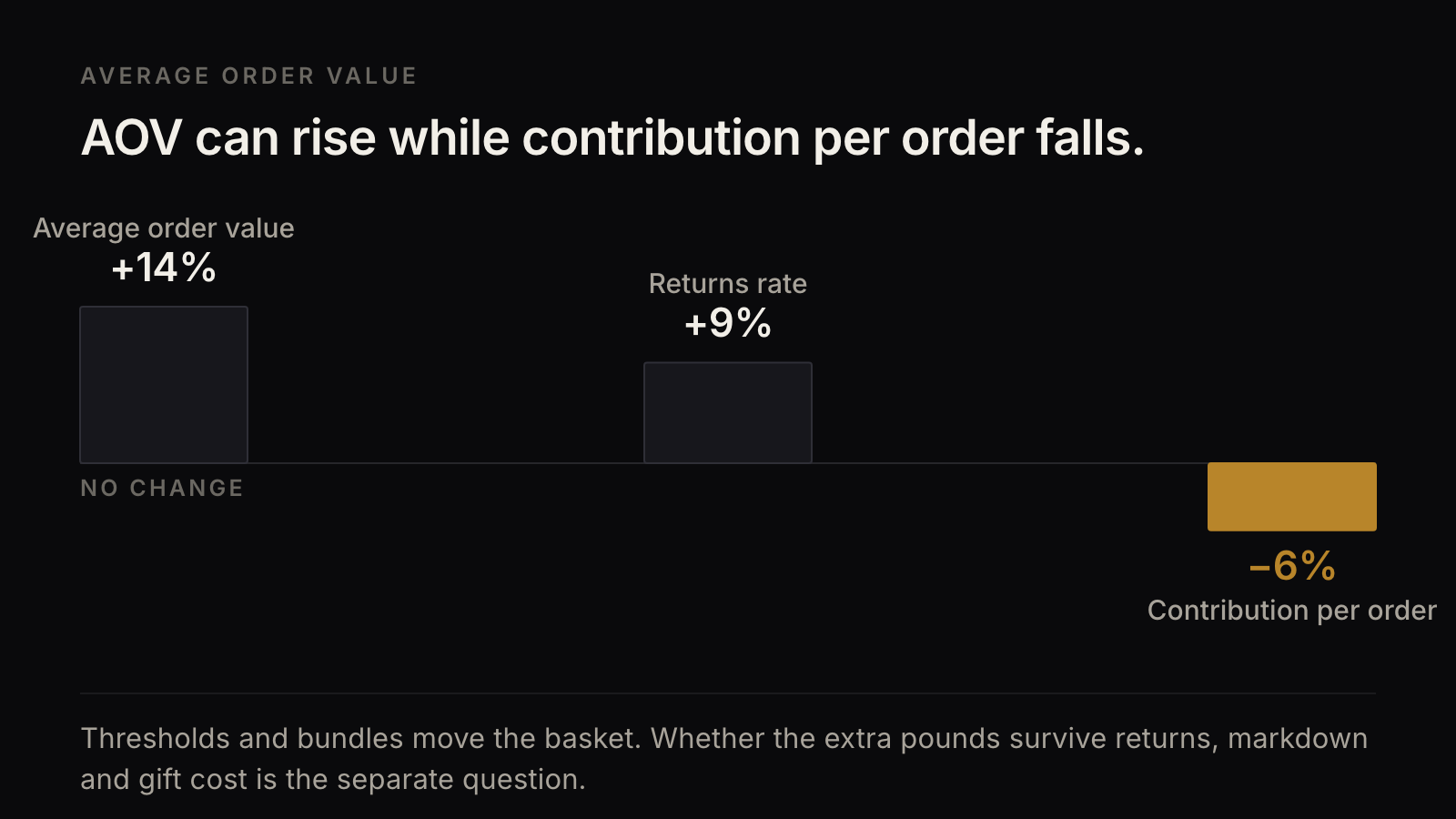
A larger basket can be the right commercial move. It can also be a second item that comes back, a kit with worse margin, or a threshold gift that was never in the unit model. The tile still rises. The month does not.
If you start with an upsell widget, you will A/B a carousel on a leak you have not located. Fashion “add the second size” and beauty “add the kit” often look like AOV wins. Sometimes they are. Sometimes they are a return and a sample cost you did not price.
Walk three buckets in order. Stop when one explains the week you care about.
Bucket 1: mix and the first SKU
AOV moves when the sessions change.
If last month you bought more cold paid, lost branded search, or pushed a harder first product, the basket will look thinner. The merchandising grid did not get worse. The mix did. Raising a threshold, or installing a second-item widget, will decorate a traffic problem.
A first hour on mix:
- Confirm you are looking at the same AOV definition as last quarter. Shopify, GA4, and the ads manager do not always count the same order, refund, or currency.
- Split AOV by channel and device for the same weeks. If paid AOV fell and branded held, stop decorating
/cart. - Check whether the first SKU in those orders shifted. A replenishing serum and a seasonal outerwear drop do not build the same basket.
If step 2 or 3 explains the fall, reset the baseline or change what you buy traffic against. Ecommerce merchandising is the sibling when the first product is a range bet. How to improve ecommerce conversion rate is the order of look when the tile is conversion and the mix moved.
Fashion drops make this worse. Three good weeks of full-price baskets can hide a thin AOV once the colourway is on sale. Beauty kits can lift AOV on a gift week and still be a one-time purchase.
Bucket 2: the basket change
If the mix is stable and the same channels now leave with one item, you have a basket problem.
Then the method is a walk, not a plugin list.
On a phone, as a guest, on the three PDPs that already get traffic:
- Can they see a second item that belongs with the first, at a price you can live with, without a surprise at
/checkout? - Does
/cartpush a discount or a free-shipping bar before it answers size, shade, or delivery? - For fashion, is the second size or the care item still visible once they have left the PDP?
- For beauty, is the kit a real pair or a deluxe sample that never sat in the margin model?
A threshold can be the right tool when the page already shows the next honest add. It is the wrong tool when it is the only idea and the first SKU is the leak.
Fix the step that fails the walk. Do not install three apps that all claim the same AOV number.
Bucket 3: is the extra AOV still contribution
The last bucket is the one the apps skip.
Open a sample of orders where AOV rose after the change. How many added a second item that later returned? How many used a code they did not need? How many were a kit whose gift COGS ate the lift? How many look like a genuine second product at full price?
If the incremental slice is thin, you do not have an AOV programme. You have a larger invoice with the same contribution, or worse.
Fashion “order two sizes” will lift AOV and return rate together. Beauty gift-with-purchase will lift AOV and hide cost. Both can be right in a week you need cash. Neither is proof the basket is healthier.
You will not get that read from a homepage screenshot. You need orders by first SKU, by the second line, and by whether a refund followed. That is diagnostic depth. It is not an AOV blog method.
A sequence you can run this week
Keep it short. One week of data is enough to choose a bucket. It is not enough to finish the diagnosis.
- Pick one week with an AOV you dislike. Name the definition you will hold constant.
- Split by channel and first SKU. If mix moved, write that down and stop.
- If mix did not move, walk the three busiest PDPs and
/carton a phone. Write the first broken add. - Only then look at the “win”. Pull a sample of larger baskets. Mark which ones still look like contribution.
If you cannot do step 4 without a join between orders, returns, and the offer that sat on the basket, that join is the work. Not another widget.
A sample of thirty larger orders is enough to see a pattern. Mark each one: second item later refunded; gift cost never modelled; code they did not need; or a second product at a price you can keep. If most of the sample is the first three, the AOV project is a costume.
TwoKai starts with the outcome. A healthier basket, or a stop to paying for a larger invoice that does not contribute. Then we engineer the route. Sometimes that is a merchandising change. Sometimes it is a measurement join. Sometimes it is leaving the threshold alone.
What's missing
This article can give you an order of look: mix and first SKU, then the basket change, then whether the extra AOV is still contribution. It cannot tell you which bucket is true on your orders, or which larger baskets paid for themselves after returns and gifts. That split lives on your catalogue.
Related: Unit economics for Shopify fashion and beauty · Ecommerce merchandising: what to measure under the word
If you want that investigation led as one commercial piece of work, Explore an opportunity with TwoKai.