Ecommerce attribution: what it can and cannot establish
People search for ecommerce attribution when three tools report three different numbers for the same week and a decision is due on Friday. Shopify shows one figure. Meta shows another. GA4 shows a third. Somebody asks which one is right.
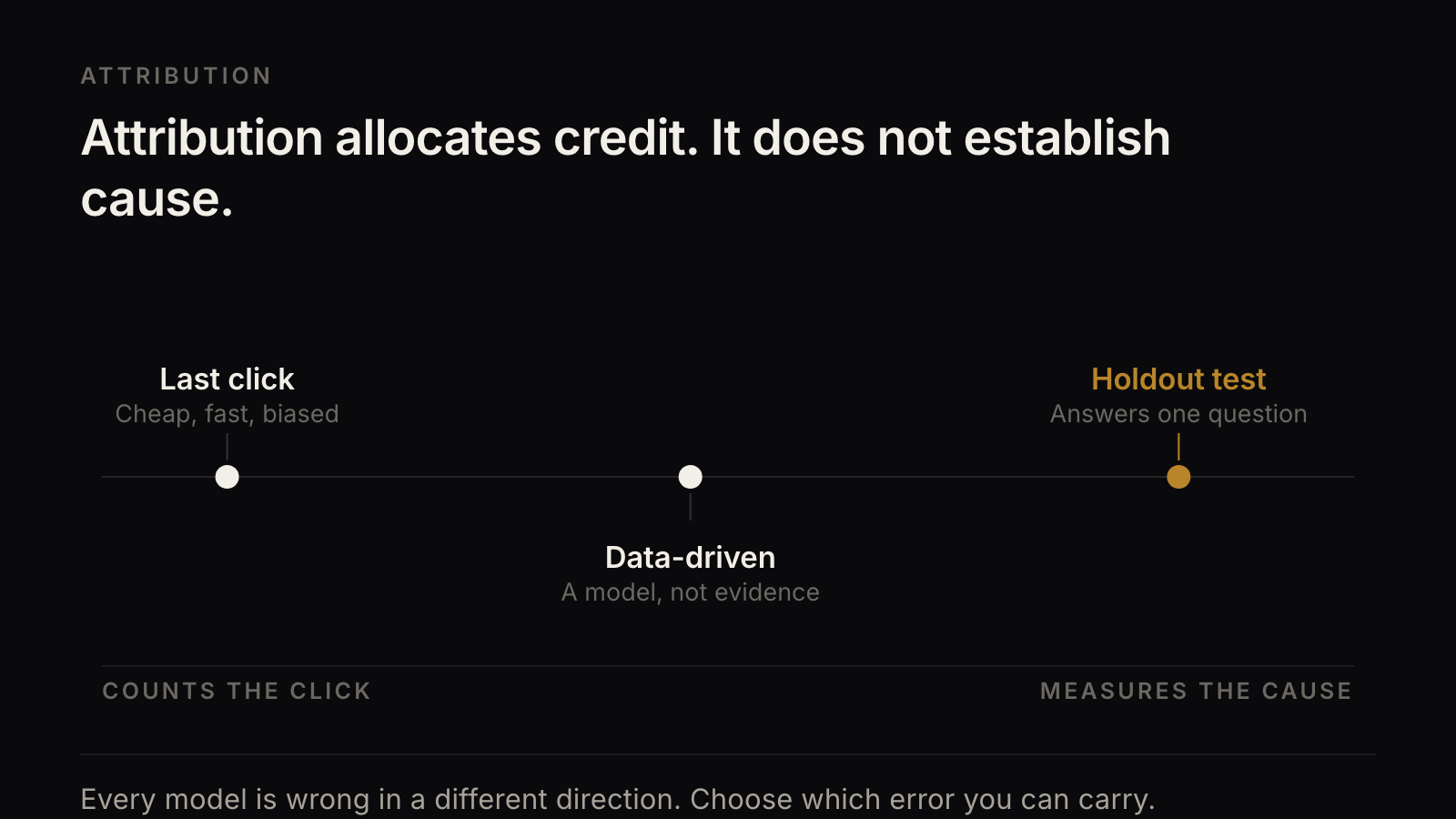
None of them is right in the way the question means it. Attribution allocates credit for orders. It does not establish that the credited touchpoint caused them. Those are two separate jobs, and the meeting usually wants the second one.
MER vs ROAS is the page for reconciling the tiles you already have. Incrementality testing in ecommerce is the page for designing a test that can settle a spend line. This page sits above both. What attribution is, what it can and cannot establish, and how to choose an approach you can defend when the numbers move.
What attribution actually does
Attribution takes the orders you received and assigns each one to a touchpoint, or splits it across several. That is the whole mechanism. Revenue arrives and a rule decides who gets to claim it.
The rule is a choice. In most stores the platform made it, and it is a default nobody has looked at since the ad account was opened.
This is why credit and cause come apart. A model can hand brand search 40 per cent of a week's revenue and be correctly configured, internally consistent, and completely silent on whether brand search made a single extra order happen. The customer typed your name because of a drop email, a friend, or a bag they saw on the train. The model saw the click.
Hold those two ideas apart and most attribution arguments get shorter. Who gets credit is a bookkeeping question. What the spend caused is an experimental question. They are answered with different work.
The main approaches and what each is good for
Six approaches cover almost every ecommerce setup. Each one is honest about something and blind to something else.
Last click. The final click before the order takes all the credit. It is cheap, stable and easy to explain to a board. It also overpays the bottom of the funnel: brand search, retargeting, and the discount code affiliate who appeared after the decision was made. Use it to operate inside a channel this afternoon. Do not use it to decide where the next £50,000 goes.
First click. The first click takes everything. It flatters discovery and ignores the work that closed the sale. As a contrast to last click it is valuable, because the gap between the two tells you how long your real consideration window is.
Position based. Typically 40 per cent to the first touch, 40 per cent to the last, and 20 per cent shared across the middle. There is no evidence behind those weights. They are a convention, which is fine if you need one number that leans neither way and everyone knows how it was built.
Data-driven modelling. The platform or your warehouse fits the weights from observed paths instead of assuming them. Better than a fixed rule once you have volume. It can only learn from journeys it can see, so consent refusal and cross-device gaps are built into what it learns. Most implementations are also closed, which makes the output hard to audit.
Media mix modelling. Regression on aggregate spend and outcomes over time, with no user-level data needed. It survives tracking loss, it can hold offline and brand spend, and it answers budget questions at channel level. It wants a long clean history, it is coarse, and it will never tell you which ad set to pause today.
Holdout or geo testing. You withhold spend from a slice of people, regions or auctions and compare. This is the only approach in the list that measures cause. It is also the slowest and the most disruptive, and it answers one question at a time.
Why the models disagree by design
Operators lose weeks treating the disagreement as a broken pixel. Usually it is four structural differences, and all four are intentional.
The window. Meta may look back seven days from a click. Google may look back thirty. GA4 has its own setting. Shopify records the order on the day the money moved. Change nothing about your marketing and the same week produces different totals from different windows.
Clicks against views. Some platforms claim an order after an impression with no click at all. Others require the click. A view-through credit is real and generous. Two tools with different rules here will never reconcile.
Cross-device and cross-session. A customer sees the ad on a phone at lunch and buys on a laptop at home. Whether that becomes one journey or two depends on identity resolution you do not control.
Consent and tracking loss. Refused consent, ad blockers, Safari and iOS restrictions and app-to-web hops all remove events. The order still lands in Shopify. The touchpoint disappears. Every model then quietly reallocates that revenue to whatever it can still see, which is usually direct, email and brand search.
Add those four together and the totals cannot match. The gap between them is information about the models rather than a fault in your setup.
Choosing a model is a commercial judgement
Every model is wrong in a known direction. The real choice is which error you would rather live with.
Run last click and you will understate the top of the funnel. Cut prospecting on those numbers and you will feel efficient for two quarters, then watch new customer counts fall and blended CAC climb while every campaign tile still looks healthy.
Run first click, or a long view-through window, and you will overstate almost everything. Scale into that and reported returns stay strong while the business gets tighter.
Run media mix modelling and you get a defensible budget answer with wide error bars, six weeks after the decision you needed it for.
So the useful question is narrower. Which decision are we making, and which error can we survive if we are wrong? A weekly channel trim can tolerate last click bias. A quarterly commitment cannot. That judgement belongs to whoever owns the profit and loss rather than whoever owns the pixel.
Then pick one model as the reporting standard and leave it alone. A house model that everyone understands, with its bias written down next to it, beats a monthly argument about which dashboard to believe. Changing the model to explain a bad month is how measurement stops being trusted.
What attribution cannot establish
Three things sit permanently outside the reach of any attribution model, however well built.
Whether the order needed the spend. No credit rule contains a counterfactual. That is what a holdout, a geo split or a pause is for.
What the order was worth. Attribution reports revenue. It does not know your product cost, the discount that won the order, the shipping and payment fees, or the return that lands three weeks later. ROAS vs ROI covers what happens when you put those costs back in.
What it never saw. Consented traffic is a sample of your customers. Word of mouth, group chats, a stylist recommendation and a shop floor conversation leave no click at all. Attribution describes the visible part and cannot size the rest.
Fashion and beauty split the credit differently
In fashion the distortion follows the drop calendar. Launch week produces a heroic last-click number on retargeting, because the style was already sitting in carts from the email that announced it. The return lands after the attribution window closes, so the model keeps revenue that came back. Judge paid against the life of the style rather than the launch tile.
In beauty the distortion runs the other way. The second order on a hero serum usually arrives with no paid touch, so last click hands it to email or direct. The prospecting that created that customer four months earlier gets nothing. A model that ignores where the first order came from will underpay acquisition and overpay the reminder.
Same six approaches. Opposite failure modes. The catalogue and the repeat clock decide which one you have.
A sequence you can run this week
- Pick one week and one channel. Do not start with the blended year.
- Write the same week down from three sources: store orders, the ads manager, and GA4. Note each tool's window and whether it counts views.
- Run the same week through last click and first click. The gap is your consideration window, and it tells you how much the default model is hiding.
- Measure your loss. Compare store orders against events the platform actually received, and get a rough consent and blocking rate. You cannot judge a model without knowing what it never saw.
- Choose the reporting model for the next quarter and write its known bias in the same document.
- Take the single loudest claim in that model and test it with a pause or a holdout. One claim, one decision, one window.
You are not building a measurement platform. You are working out which of your numbers is allowed to approve money.
TwoKai starts with the outcome. A credit rule your team agrees on, and a separate piece of evidence about cause. Then we engineer the route between them.
What's missing
This page can tell you what attribution does, what the main approaches are honestly good for, and why the choice of model is a commercial judgement rather than a technical one. It cannot tell you which of your channels is claiming orders it did not cause, or what your consent and tracking loss actually is. Both of those sit on your own orders and your own event stream.
Related: MER vs ROAS: which number do you spend against? · Incrementality testing in ecommerce · ROAS vs ROI: which number can approve a budget?
If you want that measured on your own orders, Explore an opportunity with TwoKai.