What is a good add-to-cart rate?
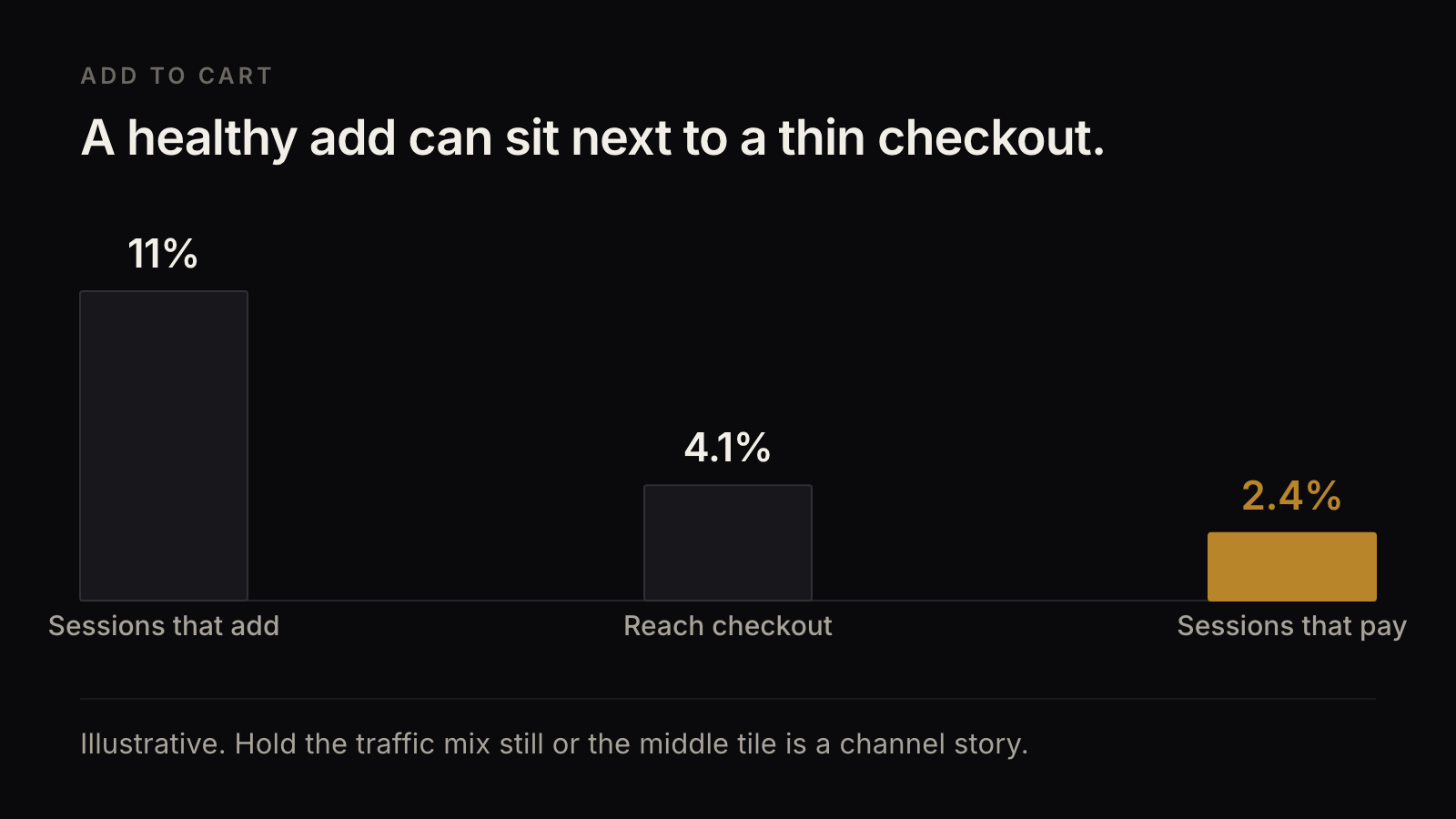
People type “what is a good add-to-cart rate” when ATC looks healthy and checkout still drops. The PDP tile is fine. The order tile is not. Someone wants a benchmark for the middle of the funnel.
There is no good ATC that is independent of the traffic you bought and the sessions you counted. A fashion prospecting session and a beauty branded session will not share a number. Comparing them is how teams conclude the PDP is “working” while the month is not.
What is a good ecommerce conversion rate is the judgment page for the last step. How to reduce cart abandonment is the method sibling once something is in the bag. This page stays on the add. What the rate counts. Why it can lie. What a good number cannot settle.
This is not a fifth CRO tips list.
What the rate counts
Add-to-cart rate is add events, or sessions with an add, over the sessions or page views you chose as the base. Teams switch the base and then fight about the percentage.
Write the fraction down.
- numerator: add events, or unique sessions that added
- denominator: all sessions, product views, or landed PDPs
- window: the week, or the campaign
A rate on product views will look higher than a rate on all sessions. Both can be honest. They are different decisions. Fashion size-two adds will inflate the numerator and then return. Beauty shade-swatches that trigger an add on a default will inflate the numerator and never mean intent.
Bots and app webviews are the usual hole. If the denominator is cheap traffic, ATC looks weak. If the numerator counts a theme quirk, ATC looks strong.
Why ATC can look healthy
ATC can rise when paid buys people who like to collect a bag and leave. Fashion two-size behaviour will do this. ATC can rise when a sticky bar adds the default variant. Beauty kits will do this.
Neither rise is a better PDP. How to improve ecommerce conversion rate is the how-to sibling when the leak is still mix versus page. This page only needs the middle metric.
Checkout abandonment can sit next to a “good” ATC and still be the same leak. The customer added. They did not mean to buy this one, or they meant to buy two sizes. Checkout abandonment rate is the sibling when the denominator of the next step is the fight.
Do not celebrate ATC in a week you also bought a cheaper prospecting mix. Hold the traffic mix still, or the rate is a channel story.
What a good rate cannot settle
Industry gossip will give you a fashion number and a beauty number. They will not tell you whether your adds are intent.
A store 11% can be 4% on cold paid and 22% on branded. The store number will send you to a PDP rewrite. The split sends you to the mix.
The rate cannot tell you whether the add will survive size, shade, and delivery. It cannot tell you whether recovery email is about to take credit for orders that would have completed.
Do not brief a PDP project off the store target. Cut ATC and paid conversion by channel and by first SKU. Hold the fraction still.
Mix versus the page
Hold the traffic mix still before you rewrite the PDP.
A week of cheaper prospecting will drop ATC and paid conversion together. That is a channel story. A week of branded demand will lift both. That is also a channel story. The page did not change.
Fashion two-size adds look like a page win. They are a range behaviour. Beauty default-shade adds look like a page win. They are a swatch behaviour.
What is a good ecommerce conversion rate already splits mix versus PDP versus checkout. ATC is the middle tile in that same split. Do not write a fifth CRO checklist on top of how to improve ecommerce conversion rate.
If ATC and paid conversion move together, the add was intent. If ATC rises and paid conversion does not, the add was a bag.
When the add is a lie
The add is a lie when the theme adds a default variant from a sticky bar. The add is a lie when a size-two habit is the product. The add is a lie when bots or a paid placement inflate sessions in one direction and events in the other.
Recovery email can then take credit for orders that would have completed, or fail to recover bags that were never meant to pay. How to reduce cart abandonment is the method sibling once something real is in the bag.
Write the fraction. Cut by channel. Sample the unpaid adds. The benchmark can wait.
A sequence you can run this week
You do not need a new analytics stack for a first read. You need one week and the mix.
- Write the fraction. Sessions with an add, over sessions. This week. Hold it.
- Split by channel. Paid prospecting versus branded versus email.
- For the channel that grew ATC, pull paid conversion on the same sessions.
- Sample twenty adds that did not pay. Mark size-two, default variant, and left for delivery.
If ATC rose and paid conversion did not, the middle tile is the wrong instrument.
If the unpaid sample is two sizes or a default shade, the PDP is collecting bags. It is not collecting orders.
TwoKai starts with the outcome. An add that means a basket you can defend. Then we engineer the route.
What's missing
This article can say what ATC counts, and why a healthy add can sit next to a thin checkout. It cannot tell you whether your leak is mix, the PDP, or a rate that counts the wrong sessions. That split lives on your traffic and your bags.
Related: What is a good ecommerce conversion rate? · How to reduce cart abandonment · How to improve ecommerce conversion rate · Checkout abandonment rate · Explore an opportunity with TwoKai
If you want that investigation led as one commercial piece of work, Explore an opportunity with TwoKai.