How to reduce cart abandonment
Cart abandonment is a short noun with a long industry behind it. Recovery apps. Abandoned-cart email. Shopify-branded help articles. Most of that SERP will sell you a message or a pop-up.
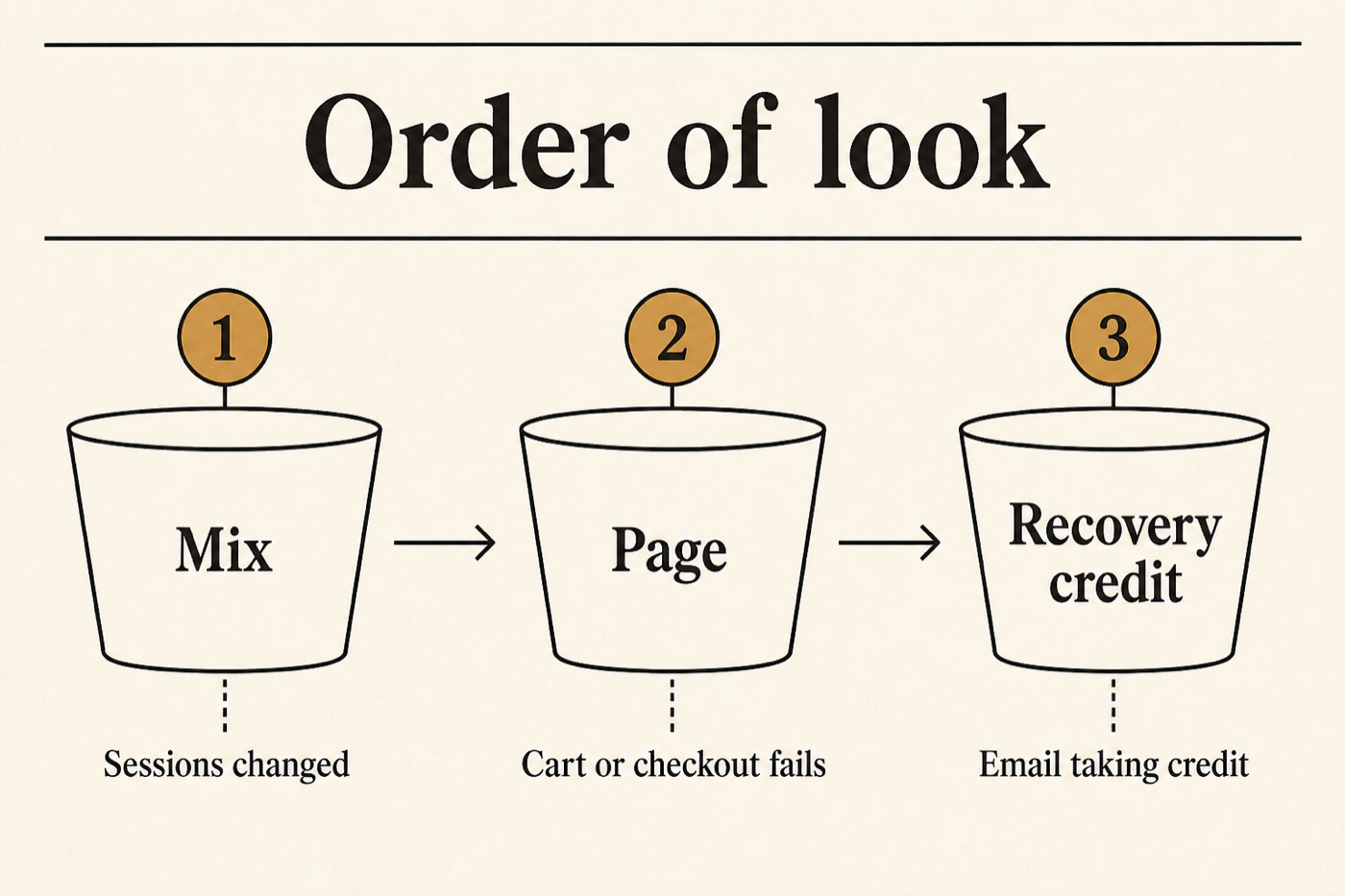
The operator problem is older. Someone reached /cart or /checkout and did not pay. You want fewer of those sessions. The useful work is an order of look. Mix first. Then the page. Then whether recovery is taking credit for orders that would have completed anyway.
This is not a second how to improve ecommerce conversion rate page. That piece is the storefront checklist and the mix-versus-page warning. This one is the cart-shaped method. Same family of leak. Different stem. Do not turn it into an email-template gallery.
Do not start in the inbox
Abandoned-cart email is a real search. Klaviyo and template galleries own it. A flow can recover some orders. It can also claim orders that were going to complete on the second visit. That is a credit problem, not a copy problem.
If you start in the ESP, you will A/B subject lines on a leak you have not located. Fashion size hesitation and beauty shade hesitation often look like “they abandoned”. Sometimes they needed a day. Sometimes the PDP never answered the question. Sometimes you bought traffic that was never going to pay.
Walk the three buckets in order. Stop when one explains the week you care about.
Bucket 1: mix
Cart rate moves when the sessions change.
If last month you bought more cold paid, lost branded search, or pushed a harder first SKU, more people will reach /cart and leave. The cart did not get worse. The mix did. Rebuilding checkout, or adding another reminder, will not fix that.
A first hour on mix:
- Confirm you are looking at the same cart definition as last quarter. Shopify, GA4, and the ESP do not always count the same step.
- Split add-to-cart and checkout start by channel and device for the same weeks.
- Check whether the SKUs in those carts shifted toward a higher-consideration line. A linen shirt and a replenishing serum do not abandon for the same reasons.
If step 2 or 3 explains the rise, stop decorating /cart. Reset the baseline or change what you buy traffic against. What is a good ecommerce conversion rate is the judgment on the range. Use it when someone treats a fashion 1–2% as a cart emergency.
Bucket 2: the page
If the mix is stable and the same channels now die more often on /cart and /checkout, you have a page problem.
Then the method is a walk, not a plugin list.
On a phone, as a guest:
- Can you see line items, size or shade, and the price you will actually pay, including shipping, without a surprise at the next step?
- Does
/cartpush a discount before it answers fit or delivery? - Does
/checkoutask for an account, a long form, or a payment method that fails on that device? - For fashion, is size guidance still visible once they have left the PDP?
- For beauty, is the shade they picked still obvious, or did the cart collapse it to a SKU code?
Speed matters. So does trust. So does the moment you introduce a threshold (“free shipping over £50”) that they only discover after add-to-cart.
Fix the step that fails the walk. Do not install three apps that all claim the same abandonment number.
The CRO piece lists PDP, speed, size and shade, cart, and checkout as a storefront order. Use that checklist once mix is ruled out. This page will not repeat it as a tips list.
Bucket 3: recovery credit
Recovery is last on purpose.
A reminder can be the right tool when the page is sound and the session was a pause. Size research. Shade comparison. A delivery check. Fashion and beauty do that more than a replenishing household good.
It is the wrong tool when you use it as proof that the programme works. Open the orders the flow “recovered”. How many had already opened checkout twice? How many came back on branded search the same day? How many used the code and would have paid full price?
If the flow’s incremental slice is thin, you do not have a cart-recovery win. You have a discount on demand that was already there. That is a contribution leak with an email costume.
Do not write this as “how to write an abandoned cart email”. That SERP is templates and ESPs. The missing part is incrementality on your recovered orders.
A sequence you can run this week
Keep it short. One week of data is enough to choose a bucket. It is not enough to finish the diagnosis.
- Pick one week with a cart or checkout rate you dislike. Name the definition you will hold constant.
- Split by channel and device. If mix moved, write that down and stop.
- If mix did not move, walk
/cartand/checkouton the top two devices. Write the first broken step. - Only then look at recovery. Pull a sample of “recovered” orders. Mark which ones look incremental.
If you cannot do step 4 without a join between the ESP and orders, that join is the work. Not another template.
A sample of thirty recovered orders is enough to see a pattern. Mark each one: already in checkout twice the same day; came back on branded search; used a code they did not need; or looks like a pause that needed a reminder. If most of the sample is the first three, the flow is a discount machine. If most of the sample is the fourth, keep the reminder and fix nothing else until mix or page moves.
Fashion size research and beauty shade comparison produce more genuine pauses than a replenishing household SKU. That is why a fashion or beauty cart rate can look “high” next to a generic ecommerce blog average. Do not manage to that average.
TwoKai starts with the outcome. Reduce wasted carts that were going to pay, or stop paying to recover demand you already had. Then engineer the route. Sometimes that is a page change. Sometimes it is a measurement join. Sometimes it is leaving the flow alone.
What's missing
This article can give you an order of look: mix, then page, then recovery credit. It cannot tell you which bucket is true on your sessions, or which recovered orders were incremental. That split lives on your carts, your channels, and your ESP. Not on an app store page.
Related: What is a good ecommerce conversion rate · How to improve ecommerce conversion rate
If you want that investigation led as one commercial piece of work, Explore an opportunity with TwoKai.