Meta Conversions API: what it changes commercially
Somebody has been told to set up the Meta Conversions API. An agency raised it, or a developer did, or it appeared in a quarterly plan. Nobody in the room has said what it changes commercially, so the question turns into a ticket and the ticket gets an estimate.
It is worth answering the commercial question first. The Conversions API sends purchase and event data to Meta from your server instead of relying only on the browser. That has a real effect on what the platform can optimise towards, and a real effect on the numbers you report. Those two effects are not the same size, and they do not arrive at the same time.
Why the store and the platform disagree
Your store counts orders. The platform counts events it was told about.
Shopify knows about every order because the money moved through it. Meta only knows about the orders where a browser successfully fired an event, that event survived the trip, and the platform could tie it back to somebody who saw an ad.
Those are two different populations. The store's count is close to complete. The platform's count is a sample, and the sample is not random. It skews towards customers with permissive browsers, no ad blocker, one device and one session. In practice that means it under-represents younger mobile-first shoppers, which for a beauty brand is often the audience you are actually buying.
This is the tracking layer. It sits underneath the attribution argument about which tool gets credit, covered in ecommerce attribution. Before you can argue about who claims an order, the order has to arrive in the system at all.
Why browser events go missing
A browser event is a small message fired by JavaScript in the customer's browser. It has to load, execute, and reach the platform. Several things stop it.
Consent refusal. If the customer declines marketing cookies, the tag should not fire. That is the design, and in some markets a refusal rate near half is normal.
Ad blockers and privacy extensions. These block the request outright. The order still completes. The event never leaves the machine.
Safari and iOS restrictions. Tracking prevention shortens or removes the identifiers that let the platform match a purchase to an ad impression. The event may arrive with nothing useful attached to it.
Checkout and app quirks. Single page checkouts, wallet payments, in-app browsers and payment redirects all break the sequence in which a page is expected to load and fire. A customer who pays with a wallet inside a social app browser is a common miss.
Everything ordinary. A dropped connection, a closed tab, a slow script, a customer who returns to the tab an hour later.
None of this is a fault you can configure away. The result is a persistent gap between orders in your store and purchases the platform recorded.
What the server-side event adds
A server-side event is sent from your systems to the platform after the order is confirmed. It does not depend on the customer's browser, their extensions, or the checkout rendering path.
That changes three things.
It recovers events that were lost in transit for technical reasons. Wallet payments, in-app browsers and script failures largely stop being invisible.
It sends better identifiers, because your server knows things the browser could not confirm. Email, phone, name and address exist in the order record, hashed before they are sent.
It reports later actions that never had a browser at all. A subscription renewal, a phone order or a delayed payment can be sent as an event because your system knows it happened.
What it does not do is override consent. If a customer refused marketing tracking, that refusal has to be honoured server-side too. Any setup that treats the server route as a way around a consent decision is a legal problem wearing an engineering hat, and it is the first thing worth checking about a proposed implementation.
Match quality and what the platform buys next
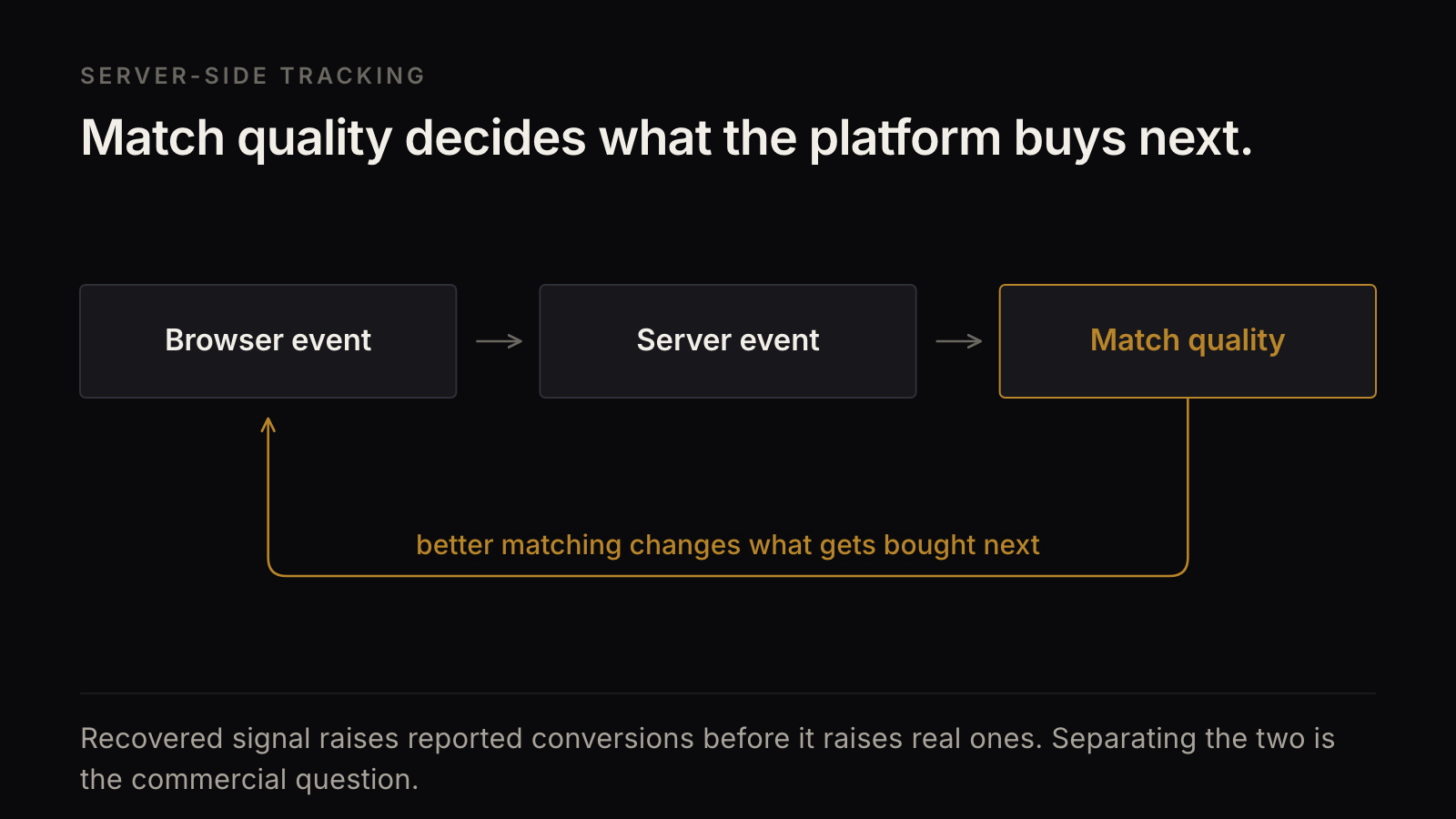
Match quality is the platform's own measure of how confidently it can tie your events to real people in its graph. More reliable identifiers on more events means a higher score.
The score itself is not the point. What it drives is.
Meta optimises delivery by learning which kinds of people convert and then finding more of them. That learning runs on the events it can match. If a third of your purchases never arrive, or arrive with nothing attached, the platform is learning from an incomplete and skewed picture of your buyers. It then goes and buys more of the audience in that picture.
So poor matching does not only understate your results. It quietly changes who the platform pursues with your budget. A fashion brand whose full-price customers browse on a locked-down mobile browser, while its discount hunters shop on desktop, can end up with an algorithm trained mostly on discount hunters. The reporting looks acceptable. The mix drifts.
Better matching improves the training data. That is the mechanism through which this work can genuinely earn money, and it is slower and less visible than the change in the report.
Is it worth the work
There is an honest commercial case and there is a mirage, and they turn up in the same week.
The mirage is recovered reporting. Send the events you were previously losing and reported purchases rise, reported cost per acquisition falls, and reported return on ad spend improves. Nothing about the business changed. You are now counting orders you were already getting. Anybody presenting that as growth is presenting a measurement change as a commercial result.
The real case is optimisation. Better signal changes what the platform buys, and that can lower genuine acquisition cost over the following weeks. It is a smaller number than the reporting jump and it takes longer to appear.
Telling the two apart is the whole job. Watch total store orders and revenue across the switch rather than platform-reported conversions. If store orders are flat while reported purchases climb 30 per cent, you recovered reporting. If store orders and new customer counts move too, something commercial happened. MER vs ROAS is the page on holding those two views side by side, and a holdout is what settles it properly.
Two things make the work an easy yes. A high share of mobile or in-app traffic, and a visible gap between store orders and platform-recorded purchases. If your gap is small and your traffic is desktop-heavy on a permissive browser, the return is thinner and there is probably a better use of the same engineering week.
What's missing
This page can tell you why the tracking layer loses events, what a server-side signal adds, and why better matching changes what the platform buys with your budget. It cannot tell you your own event loss rate, which is the number that decides whether the work is worth doing. It also cannot tell you, after the fact, whether the lift you saw was real volume or recovered reporting. That answer needs your store orders and your event stream compared over the same window, with a control you agreed in advance.
Related: Ecommerce attribution: what it can and cannot establish · MER vs ROAS: which number do you spend against? · Incrementality testing in ecommerce
If you want that measured before the engineering time is committed, Explore an opportunity with TwoKai.