Fashion and beauty brand consultant: three jobs, one title
People search for a fashion or beauty brand consultant when the brand looks right and the number does not. The photography is good. The range reads well on the site. Contribution is thin and nobody in the meeting can say which part of the business is causing it.
Then the shortlist arrives and it splits in half. One candidate talks about positioning for an hour and goes quiet when you ask about markdown. Another reads your trade report in ninety seconds and has no view on what the brand should stand for. Both are credible. Neither covers the whole brief.
This is not a second ecommerce consultant vs agency vs fractional page. That one compares hire models by who owns the P&L. This one stays on the category-shaped search. What gets sold under the title, and how to tell which version you need.
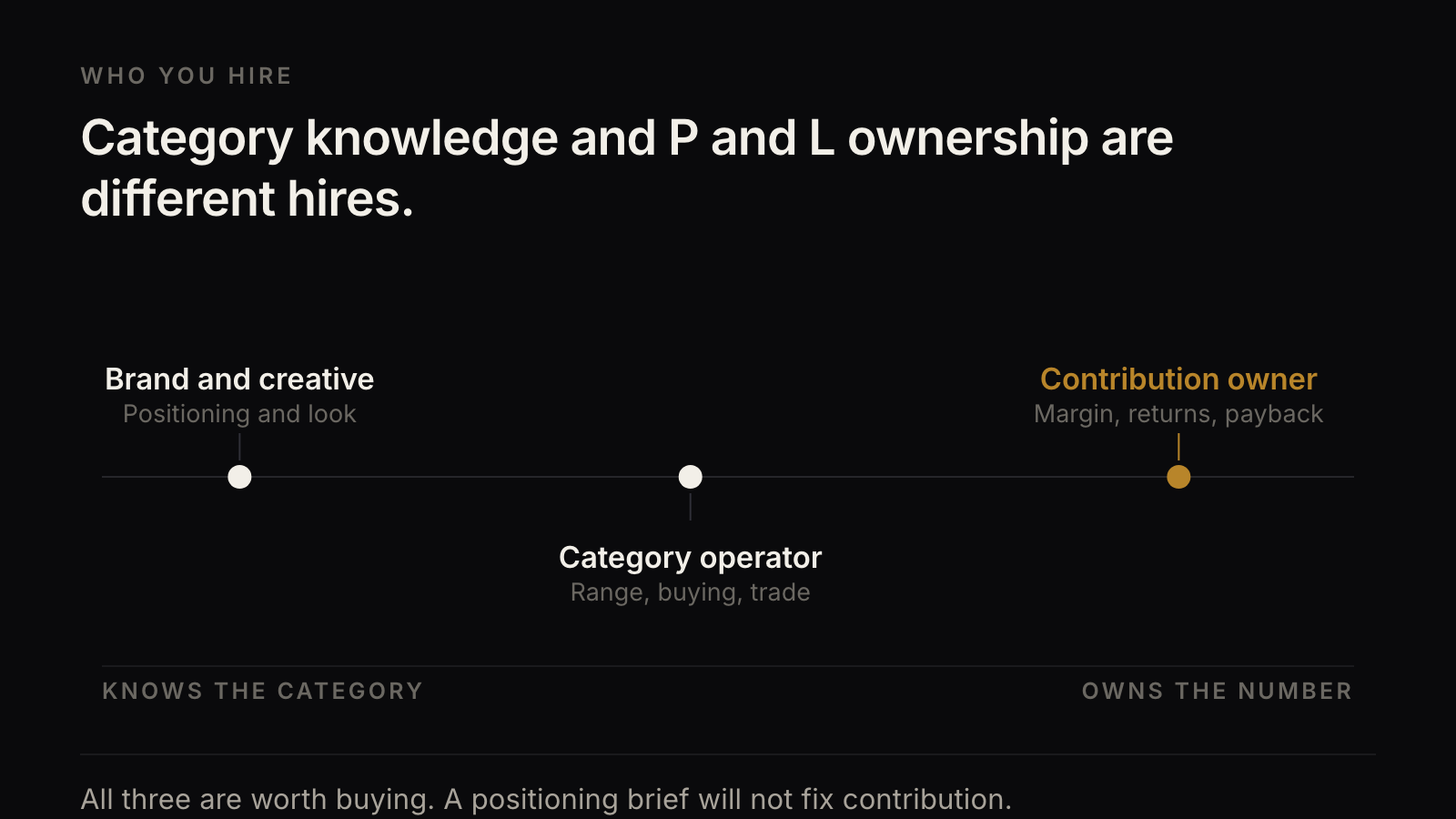
Three jobs sold under one title
Most briefs at this stage collapse three separate jobs into one word.
Brand and creative. Positioning, look, tone. What the brand claims, who it is for, how it sounds on a product page and in a launch film. This work decides whether a customer can tell you apart from the four other labels in the same feed. It is judgment about meaning.
Category operator. Range, buying, trade, markdown rhythm. How many options go in the drop and what depth to buy per size. When to take the first markdown. What to repeat and what to kill. In beauty the same job covers shade depth, kit construction, and whether the hero SKU can carry the rest of the range. This is a person who has traded a season and carries the scars.
Contribution owner. Margin, returns, payback. What an order is worth after product cost, shipping, payment fees, returns and markdown. Whether the first order pays for itself, and when. Whether a channel that looks efficient is buying demand you already had.
Three jobs. One search term. The word consultant does not tell you which one is sitting across the table.
Ask what they will still be in the room for after the workshop. If the answer is a brand book, you bought creative. If the answer is a range plan, you bought a category operator. If the answer is a named number, a change, and a measurement afterwards, you are closer to someone who can sit on contribution.
Why category knowledge and P&L ownership sit apart
These two skills are learned in different buildings.
Category instinct comes from trading. Buyers and merchandisers learn it by committing money to a range, watching it sell or fail, and clearing what is left. They know what a size curve does in week six and how a shade ladder behaves once the mid tones sell out.
Contribution ownership comes from finance and from channels. It is learned by reconciling what the platform reported against what the bank received, and by finding the returns that landed after the attribution window closed.
Both are real skills. They rarely sit in one head because the career routes do not cross. A merchandiser is measured on sell-through and terminal stock. A performance lead is measured on efficiency and payback. Each can be excellent and still hold a partial view of the same order. Brand and creative sits further out again, judged over quarters and often by people who never see the returns file.
What each one is genuinely worth buying
Buy brand and creative when nobody knows what you are. Traffic arrives, bounces, and the product is not the reason. A new label competing on the same feed as ten others. A relaunch after a founder change. Creative work will not fix a returns problem and should not be asked to.
Buy a category operator when the range itself is the problem. Too many options and not enough depth. A drop cadence that trains people to wait for the sale. Sizes that clear at full price sitting next to sizes that never do. Beauty brands hit the same wall with kits that discount the hero product and shades bought evenly when demand was not even.
Buy a contribution owner when the range is fine, the brand is fine, and the money still does not work. Paid looks efficient on the platform and the month loses. Second orders are rare and only arrive behind a code. Unit economics for a Shopify fashion or beauty brand is the arithmetic underneath that decision.
One caution on scope. A partner who only knows the category will optimise the range and hand back the P&L. A partner who only knows the P&L will cut the assortment to the four styles that pay and leave you with a shop that has nothing to say. Both outcomes are avoidable if you name the constraint before you hire.
Naming the constraint is the first piece of work
Start with what you can already see on your own orders.
Look at full-price sell-through by option. If most of the range never sells at full price, the constraint is range and buying, and a positioning exercise will not touch it. Look at returns by size and shade. If one size comes back far more often than the rest, that is a product and fit problem wearing a marketing costume. Look at what happens to an order after the platform reports it. If contribution is thin on your best-performing product, the leak is unit economics.
Then look at sessions on a healthy traffic mix. If people arrive on your strongest product and leave without a size or shade question being answered, the constraint may genuinely be what the brand communicates. Ecommerce merchandising is the sibling on how the range is presented once you have made those calls.
Two practical rules. Hire the shape that matches the constraint. Ease of interviewing is not a reason. And if you cannot name the remainder after listing what your team and current suppliers already own, you are not ready to hire. You are ready for a short investigation.
TwoKai starts with the outcome. Then we engineer the route around the range, the stack and the partners you already have.
What's missing
This article can tell you what the three jobs are, why they rarely sit in one person, and what each is worth buying for. It cannot tell you whether your own constraint is positioning, range, or unit economics. That answer sits in your sell-through, your returns file and your order-level margin. Not in a job title.
Related: Ecommerce consultant vs agency vs fractional · Fashion ecommerce agency · Unit economics for a Shopify fashion or beauty brand
If you want that constraint named on your own numbers, Explore an opportunity with TwoKai.