Ecommerce return rate: what the number is hiding
People type “ecommerce return rate” when the rate looks high and nobody agrees what is in it. Revenue printed. Stock came back. Contribution on the first order was a wish. Someone asks for a benchmark.
Unbranded ecommerce return rate is the operator stem. Shopify Returns is a Help Center page. Brand-return queries are navigational. This page stays on the commercial number. What the rate counts. Why fashion and beauty do not share a good one. What an average hides.
Unit economics for a Shopify fashion or beauty brand already puts returns in the line. Ecommerce merchandising is the sibling when the range trained the send-back. This page is the rate itself.
What sits in the rate
A return rate is returned units or returned value, over units or value you shipped, in a window you can defend. Teams switch those four choices mid-argument and then fight about the percentage.
Write the fraction down.
- numerator: units come back, or money comes back
- denominator: units shipped, or money shipped
- window: the order month, or the return month
Fashion size-two and “order both colours” will inflate units. A beauty unused deluxe will inflate value if you cost the gift at retail. Pick one fraction and hold it still.
Exchanges are the usual hole. If an exchange counts as a return and a new order, the rate looks like a disaster and revenue looks fine. If an exchange disappears, the rate looks healthy and the warehouse still did the work.
Refunds without a unit coming back are another hole. Chargebacks and “keep it” credits are not the same commercial event as a size send-back.
Fashion fit versus beauty unused
Fashion and beauty do not share a good rate. Comparing a seasonal jacket to a serum is how brands conclude they are “bad at returns” when they are looking at two jobs.
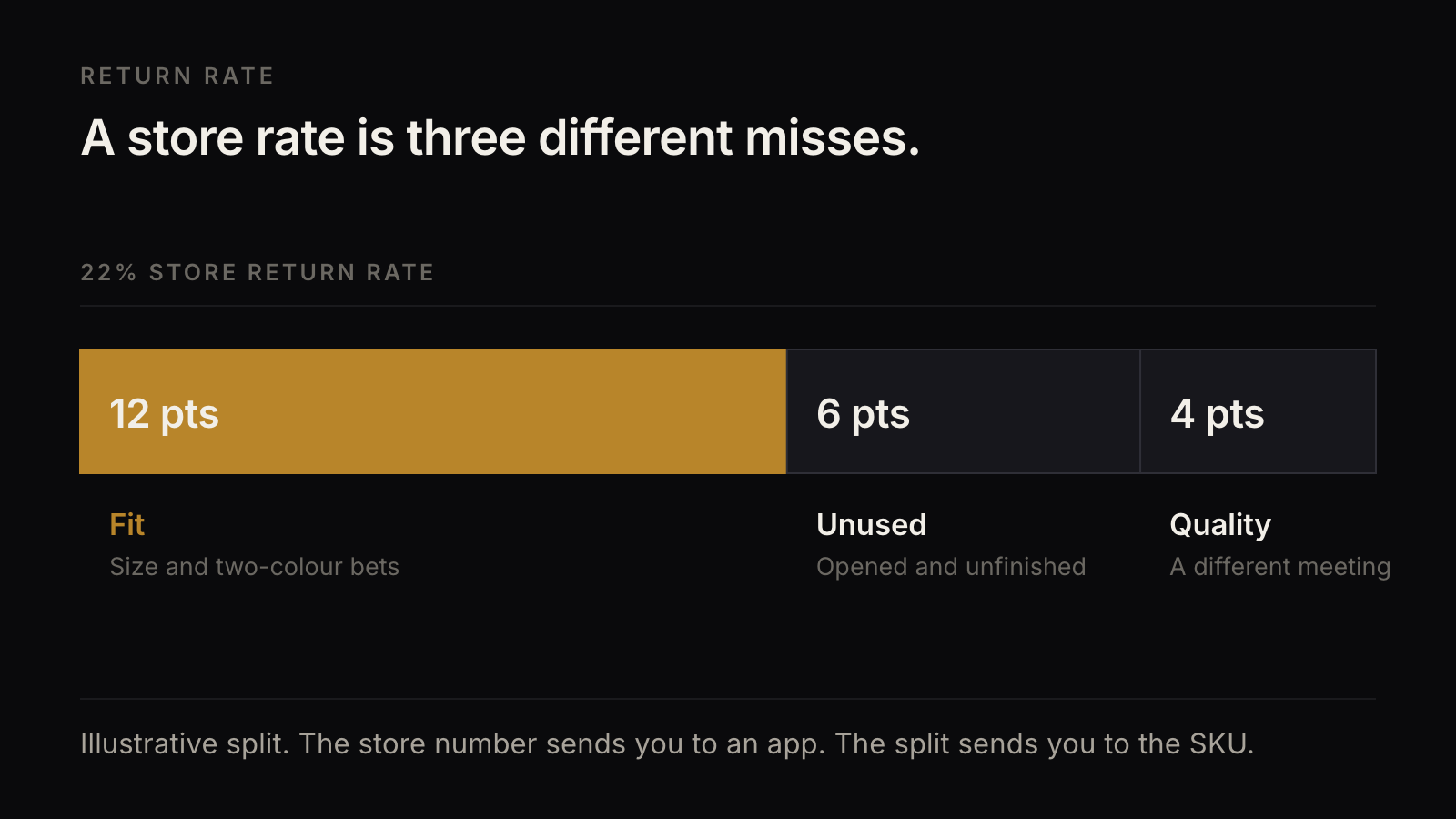
Fit. Size, length, “ordered two.” The customer wanted the product. They did not want this one. The leak is the size story, the model note, or a range that invites a two-size bet.
Unused. Beauty gift-with-purchase, a shade that looked different in daylight, a kit they opened and did not finish. The leak is the first product and the claim on the page.
Quality. Seam, smell, broken pump, fabric that was not the PDP. That is a different meeting. Do not average it into fit.
A 22% store rate can be an 8% quality problem on one hero and a 35% fit problem on a dress. The store number will send you to a returns-app demo. The split sends you to the SKU.
What is a good CAC, LTV:CAC, and payback? is the judgment page for the acquisition clock. Return rate still has to say whether that first order had anything left after the unit came back.
What a good rate cannot settle
Industry tables will give you a fashion number and a beauty number. They will not tell you whether your first products are the ones coming back.
A “good” rate on a replenishing hero can sit well under a dress programme. A “good” rate on a drop that trains two-size orders is a story you tell while contribution dies.
The rate also cannot tell you whether the return was incremental demand you never had. A paid click that returned is CAC you spent for a warehouse loop. An email buyer who exchanged into the right size may still be a customer.
Do not brief a policy change off the store average. Cut by first SKU and by reason, even in a crude export. Fit, unused, quality. Hold the fraction still.
Ecommerce contribution margin is the sibling when the question is what belongs in the line after the unit comes back.
What the warehouse loop costs
A paid click that comes back is CAC you spent for a box that travelled twice. The media tile will still look fine in the week the order printed. The month will not.
Fashion two-size bets do this at scale. You paid for a session. You shipped two. You got one back. Revenue looked like a larger basket. Contribution looked like a first-order miss.
Beauty unused does a quieter version. A deluxe or a shade they opened and did not finish still took product cost and often took a refund. If you booked the gift as marketing, the return rate stays pretty and the line does not.
What is a good CAC, LTV:CAC, and payback? already says the clock has to survive the first product. Return rate is how that clock starts on a unit that never stayed.
Do not treat a keep-it credit as the same event as a size send-back. One is a service choice. The other is a fit or quality miss you will see again.
Why a policy change is the wrong first move
Teams reach for paid returns, a longer window, or a stricter window because the store rate looks high. The policy is visible. The SKU is not.
A tighter window will not fix a dress that trains two-size orders. A paid-return fee will not fix a serum whose shade was wrong in daylight. You will move the rate a point and keep the same three SKUs.
Change the policy after you know which reason and which first product hold the value. Fit goes to the size story and the range. Unused goes to the first product and the claim. Quality goes to the supplier meeting.
Shopify Returns is a Help Center page. Size guides on a review site are a shopper page. Neither is your rate.
A sequence you can run this week
You do not need a returns platform for a first read. You need one month and the SKUs that moved.
- Write the fraction. Units or value. Shipped or ordered. Hold it.
- Pull last month’s returns. Mark fit, unused, quality. Guessing is allowed. Mark the guess.
- Rank the ten SKUs that contribute the most returned value.
- Reconstruct contribution on a sample of ten of those orders, with the return in the line.
If three SKUs are most of the value, you do not have a returns problem. You have a range or a PDP problem on those three.
If the sample’s contribution after return is below the line you would accept on a cold first order, paid on those SKUs is also the leak.
TwoKai starts with the outcome. A rate you can spend against, on the SKUs that actually come back. Then we engineer the route.
What's missing
This article can tell you what sits in the rate, and why fashion and beauty do not share a good number. It cannot tell you whether your send-backs are fit, unused, or a range that trains the next one. That split lives on your orders.
Related: Unit economics for a Shopify fashion or beauty brand · Ecommerce merchandising: what to measure under the word · What is a good CAC, LTV:CAC, and payback? · Ecommerce contribution margin · Check break-even on one order
If you want that investigation led as one commercial piece of work, Explore an opportunity with TwoKai.