DTC vs wholesale: which line still has contribution
People type “DTC vs wholesale” when wholesale looks safer and the month still does not. The wholesale line is booked. The site is noisy. Someone asks which channel they should grow.
They are asking which line still has contribution after the costs that move with it. Terms, returns, markdown, and the cost of getting the order. Fashion and beauty both run this split. A department-store door and a replenishing serum do not share a good answer.
Unit economics for a Shopify fashion or beauty brand walks the DTC order. Ecommerce contribution margin names the decision number. This page is the channel cut. What to put in each line. What teams leave out. When “wholesale is easier” is a story.
This is not a marketplace versus Amazon page.
What each line is for
DTC is a customer you acquire and keep, or fail to keep, on your own clock. You set the price. You take the return. You pay the click. You own the second order, if there is one.
Wholesale is a door that buys a pack. You give away price and often give away the customer. You take terms, markdown money, and the risk that the door does not reorder. You do not take the Meta invoice. You take a different invoice.
Both can print revenue. Only one of them, on a given SKU, may leave anything after the costs that moved.
A useful operator line for wholesale, in English:
- start with the invoice price
- take off the discount and the markdown money you already know is coming
- take off the units that will not reorder
- take off the cost of the pack, the freight you do not recover, and the sales time you actually spend
- take off payment terms as cash, not as a courtesy
What remains is wholesale contribution. It is not gross on the invoice.
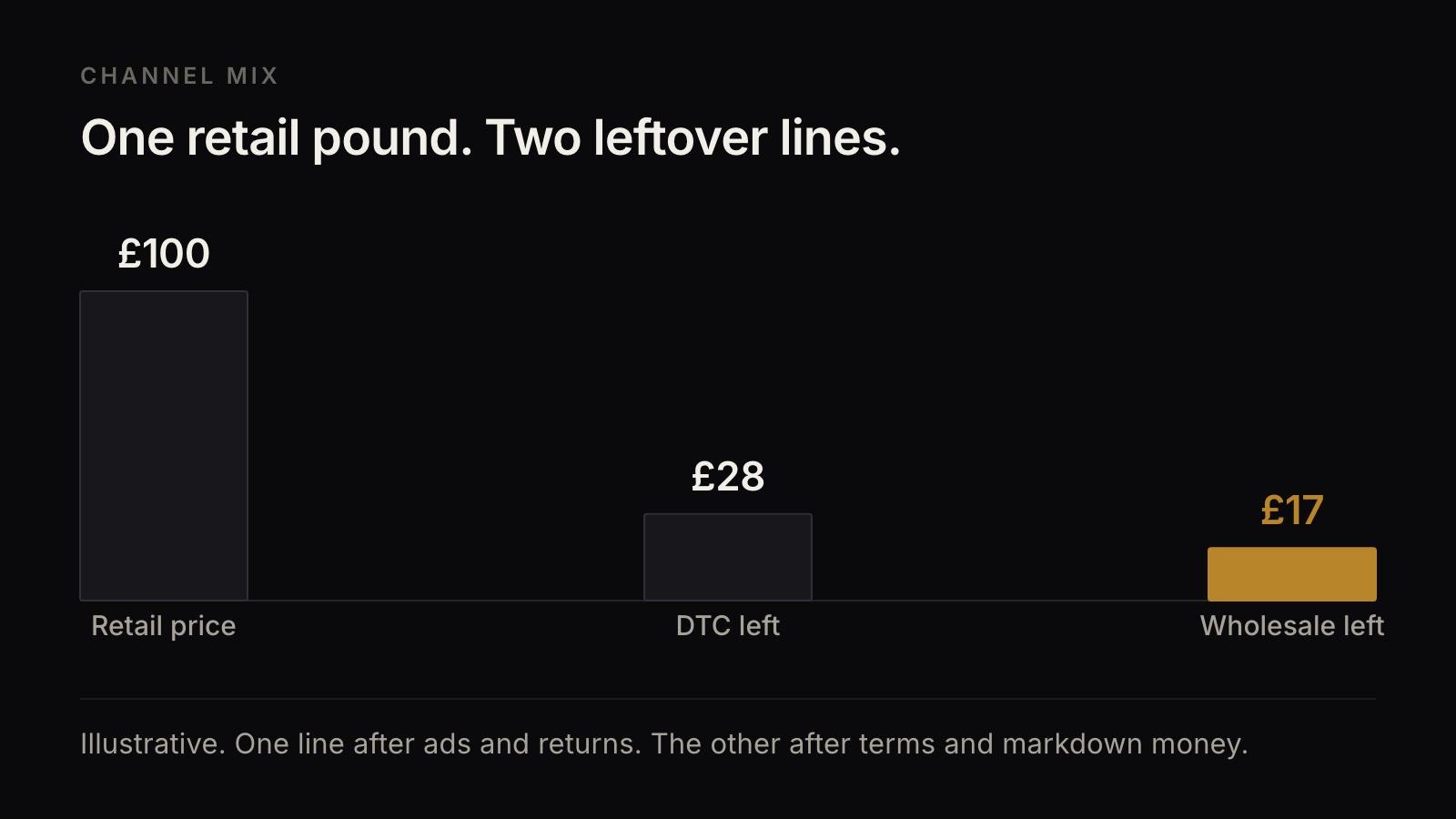
Illustratively: a £100 retail piece can leave about £28 on a DTC order once ads and returns are in, and about £17 on the wholesale invoice once terms and markdown money are in. Those are made-up numbers on a made-up SKU. The point is that both lines end well below the price on the tag, and they do not end in the same place.
DTC still uses the order line you already have: paid price, product, shipping, payment, return, gift, ads. What is a good CAC, LTV:CAC, and payback? is the judgment page for the DTC clock.
What people leave out
Markdown money. A door that takes 30% off in week six had a clock. If you only cost the pack at invoice price, you are reading launch week.
Returns and RTV. Fashion fit comes back to you or sits as a credit. Beauty unused can come back as a claim. Leave it out and wholesale looks like a hedge.
The customer you gave away. A wholesale first order can be a person you will later buy again on Meta. If you count that person as new on the site, DTC CAC is a lie and wholesale looks cheaper than it was.
Sales time. A founder still on the road is a cost. It does not sit in Shopify. It sits in the month.
Pack economics. A beauty kit that looks fine as a DTC hero can be a dog as a wholesale inner. The gift you hid in marketing is now product cost on someone else’s shelf.
Ecommerce merchandising is the sibling when the first product is a range bet on both channels.
When wholesale hides a DTC leak
Wholesale looks safer when the site is expensive. Sometimes that is true. Sometimes the site is expensive because the first SKU cannot carry ads after returns, and the door is buying the same SKU with a quieter leak.
A fashion drop that needs 40% off to move on the site will also need markdown money in the door. You did not diversify. You copied the miss.
A beauty hero that replenishes on the site and sits as a one-pack in wholesale is two businesses. The wholesale pack may still be useful as a trial. It is not a substitute for the empty-date story.
Do not decide “we should be a wholesale brand” off one quarter of site CAC. Cut the same first SKUs on both lines. If both are thin, the product is the meeting. If only DTC is thin, the leak may be mix, creative, or the page. How to improve ecommerce conversion rate is the how-to sibling when the site is the question.
Fashion door versus beauty pack
A department-store fashion door buys a depth you cannot get back in week two. Markdown money is in the terms even when nobody says it. If the colourway already needs 40% off on the site, the door is the same miss with a quieter invoice.
A beauty wholesale inner can be a trial that earns a later empty date on your site. That can be useful. It is still a different job to the DTC hero. The gift you hid in marketing is now COGS on their shelf. The customer may come back to you, or they may refill at the door.
Do not treat marketplace and Amazon as the same question as a door. Those are other channels with other fees. This page is DTC versus a wholesale invoice.
Ecommerce merchandising still applies on both sides. The first product is the bet. The channel only changes who pays the leak.
What a good mix cannot settle
A 40 / 60 revenue split cannot tell you which line still has contribution.
It cannot tell you whether the door is buying the SKU that cannot carry ads, or the SKU that can. Grow the first and you copied the miss. Grow the second and wholesale may be a real hedge.
It cannot tell you whether a wholesale first buyer is later sitting in your Meta audience as a “new” customer. If you count them twice, both CAC and wholesale “efficiency” are stories.
Hold one SKU still. Reconstruct both lines. Then talk about mix.
A sequence you can run this week
You do not need a new channel strategy for a first read. You need one SKU and both lines.
- Pick the SKU you would grow next. Write why.
- Reconstruct ten DTC orders and ten wholesale invoices on that SKU, with the costs above.
- Mark what you had to guess. Markdown money, RTV, and founder time are the usual holes.
- Compare the two contribution reads to the revenue tiles for the same month.
If the tiles say grow wholesale and the ten invoices do not, the door is not a hedge.
If DTC contribution after ads and returns is fine and you are still pushing wholesale for “brand,” say that out loud. Brand is a different job.
TwoKai starts with the outcome. A channel you can defend on the SKUs you actually sell. Then we engineer the route.
What's missing
This article can put terms, returns, and markdown on both lines. It cannot tell you which of your channels is hiding the leak. That reconstruction lives on your invoices and your orders.
Related: Unit economics for a Shopify fashion or beauty brand · Ecommerce contribution margin · What is a good CAC, LTV:CAC, and payback? · Ecommerce merchandising: what to measure under the word · Check break-even on one order
If you want that investigation led as one commercial piece of work, Explore an opportunity with TwoKai.