CAC vs CPA: which number can size a budget?
People type “CAC vs CPA” when two reports disagree in the same meeting. Paid says a customer costs £22. Finance says £43. The board pack prints both, on facing pages, with no note explaining the gap.
Neither team is wrong. They are counting different things on the top and the bottom of the sum. The two numbers answer different questions, and only one of them can size a budget.
This is customer acquisition cost. It is not the coronary calcium score. If you arrived from a medical search, you are on the wrong page.
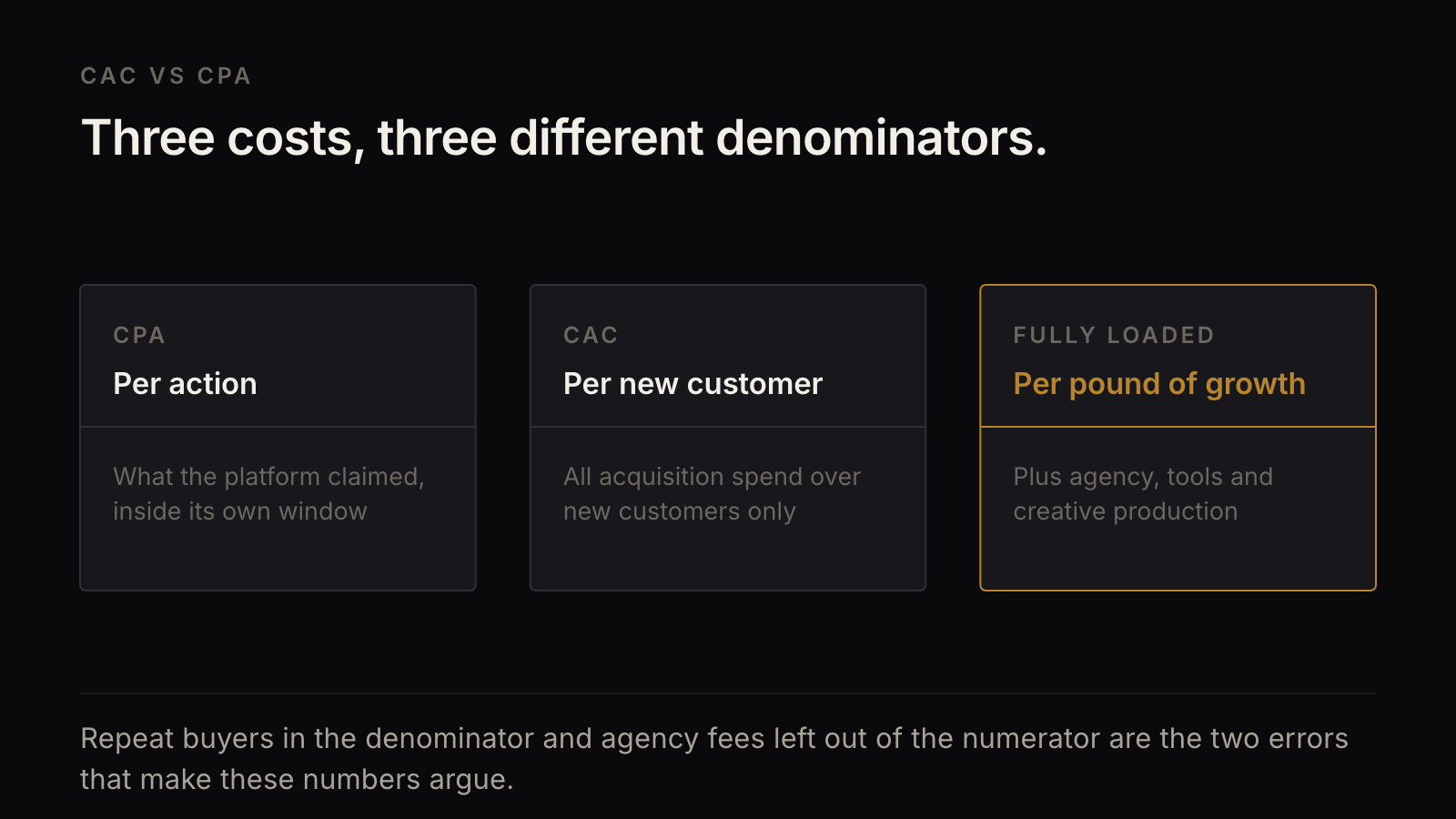
What CPA counts
CPA is cost per action. Media spend inside one platform, divided by the actions that platform claims, inside that platform's attribution window.
Three things follow from that definition.
The denominator counts actions. It does not count people. Whatever you told the platform to optimise for is what it counts. A purchase. A lead. An add to cart. If a customer who bought a serum in March buys again in June through a retargeting ad, that is an action. It is not an acquisition.
The numerator is media only. It is the invoice the platform sends you. Your agency retainer is not in it. Your creative production is not in it. Your attribution tool and your feed manager are not in it.
The window decides the week. Meta, Google and TikTok each hold their own click and view rules. Move the window and the same orders land in a different report.
CPA is a good instrument for a Tuesday. Which ad set is getting expensive this afternoon? Which creative is cheaper to serve? Those are media questions, and CPA answers them within the hour.
What CAC counts
CAC is what the business paid to get a customer it did not have before.
The numerator is every cost you incur to win first orders. Media across all platforms. Agency fees or the salary of the person doing the buying. Creative production. The tools that only exist to run acquisition. If you would stop paying for it when you stopped acquiring, it belongs in the numerator.
The denominator is new customers only, counted on your own orders. Not sessions. Not purchases. Not the number the platform reports. First orders, in the same period as the spend, from your order table.
Two rules keep it honest. Hold the definition still for the whole argument, because a numerator that grows mid-meeting is a rhetorical device. And count new customers where the truth lives, which is your orders, not a platform dashboard that has an incentive to claim them.
Blended CAC is the sibling on when an average across channels is the right instrument. What is a good CAC, LTV:CAC, and payback is the judgment page on whether the resulting number is healthy.
Where the report breaks
The gap between £22 and £43 is not a rounding error. It is three specific failures, and they compound.
Repeat buyers land in the denominator. The platform counted 500 purchases. You pull the orders and 190 of them belong to customers who had bought before. The cost per action was real. The cost per new customer is 61% higher on the same spend, before anything else changes.
Acquisition costs sit outside the numerator. The agency retainer, the creative shoot, the attribution tool and the feed app are all costs of buying customers. They are on a different invoice, so they never reach the paid report. Finance sees them. Paid does not.
The platform counted an action that was not a customer. A view-through on a branded search. A returning shopper who was going to reorder the moisturiser anyway. A fashion shopper who added three sizes and kept one. Each of those is a countable action.
Put numbers on it. You spent £11,000 on one channel. The platform claims 500 purchases, so it prints a £22 CPA. You pull those orders and 310 were first orders, which takes the media cost per new customer to £35. Add £2,400 of agency, tools and creative and the fully loaded figure is £43.
Same month. Same channel. Same spend. One number is double the other because the denominator lost 190 people and the numerator gained an invoice.
A sequence you can run this week
- Pick one channel and one month. Do not blend the year, and do not average across platforms yet.
- Write the platform CPA down and leave it alone. It is now evidence about media efficiency. It has stopped being a verdict about acquisition.
- Pull the orders that channel claimed. Mark each one as a first order or a repeat, using customer email or ID on your own orders.
- Add the costs the platform never billed you for. Agency fees, creative production, and the tools that only run because you are acquiring.
- Divide the loaded number by first orders only. That is your CAC on that channel for that month.
Five hundred claimed actions is enough to see the shape. You are not building a model. You are checking whether the number that approves spend has your customers in the denominator and your costs in the numerator.
Then say the word you mean. If you mean media efficiency, say CPA. If you mean the cost of a customer, say CAC, and be ready to show which orders were first orders.
TwoKai starts with the outcome. A cost per customer you can defend when the board asks what the money bought. Then we engineer the route.
What's missing
This page can tell you what belongs in each numerator and each denominator, and the three ways a report breaks when the two get conflated. It cannot tell you how many of your reported actions were actually new customers, or what a fully loaded cost per customer looks like on your orders once agency, tools and creative are in. That count sits in your order table and your invoices.
Related: Blended CAC in ecommerce · What is a good CAC, LTV:CAC, and payback? · LTV to CAC ratio
If you want that measured properly on your own orders, Explore an opportunity with TwoKai.