Shopify consultant: what the role actually owns
People type “Shopify consultant” when the store is live and the number is not. Paid is up. Conversion looks like fashion. The theme has been rebuilt once. Someone in the meeting says they need a Shopify person.
That search is real. It is also loose. A Shopify consultant can mean a theme builder, a freelance operator, a CRO contractor, or someone who will sit on contribution and change the system that produces it. The title does not tell you which.
This piece is not a second ecommerce consultant vs agency vs fractional page. That one compares hire models by who owns the P&L. This one stays on the Shopify-shaped search. What the role typically owns. What a theme shop owns. What you still have to find on your orders.
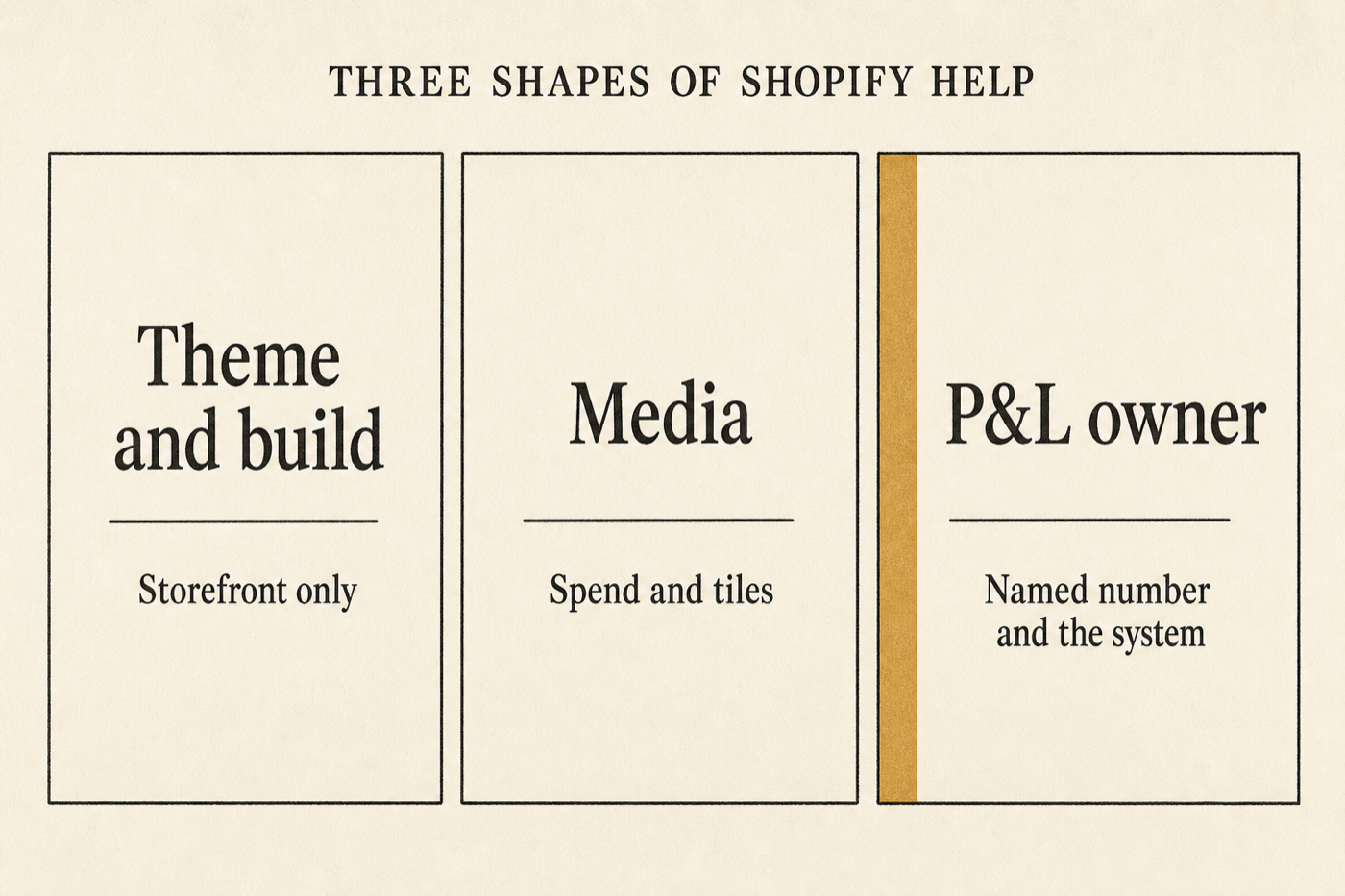
What people mean by Shopify consultant
Most briefs collapse three jobs into one word.
Theme and build. Templates, speed, apps, collection filters, a PDP that can show size or shade. Necessary when the storefront is the constraint. This is implementer work. It is often sold as consulting.
Media and the ads account. A partner who lives in Meta and Google, knows how Shopify passes events, and talks in ROAS. Useful when the leak is spend quality. Incomplete when the leak is the first SKU, returns, or /checkout.
Commercial delivery. Someone who names one number, investigates why it is stuck, designs a route around the stack you already have, and builds or briefs the change. Then they measure whether it moved. That is the only shape that owns a P&L line in any durable sense.
Ask what they will still be in the room for after the workshop. If the answer is a Figma file or a theme zip, you hired build capacity. If the answer is “we will manage the account”, you hired media. If the answer is a named objective, a change in the store or the join between systems, and a measured effect, you are closer to a consultant who can sit on contribution.
TwoKai sits in that last shape. Start with the outcome. Engineer the route. Not as a theme shop, media agency, or Shopify reseller.
What a theme shop owns, and what it does not
A theme shop or Shopify implementer typically owns the storefront. Dawn or a paid theme. App installs. Merchandising sections. The look of /collections/ and /products/. On a fashion brand that can mean size charts and lookbooks. On a beauty brand that can mean shade finders and kits.
They do not own contribution. A faster theme can lift conversion and still lose money if you bought the wrong traffic, priced into markdown, or stacked apps that tax every order. A beautiful PDP does not fix a first-SKU problem.
| Shape | Usually owns | Hands back |
|---|---|---|
| Theme and build | Templates, speed, apps, merchandising modules | Traffic mix, offer, payback, the ads account |
| Media | Spend, events, platform ROAS or CPA | Site conversion, returns, second order, unit economics |
| Commercial delivery | One named number and the system that moves it | Work that stays with your media or theme partner |
Hire the theme shop when the site is the constraint. Broken templates. Slow pages. Checkout you have not walked on a phone. Missing size or shade tools. Do not hire it as a substitute for someone who will sit on payback.
The common failure is a rebuild sold as a growth programme. Rebuilds can be the right route. They are expensive when the P&L problem was mix, offer, or measurement. Ask what commercial number the rebuild is for, and how you will know it worked.
Shopify fluency is not the same as owning the number
Shopify fluency matters. Checkout customisation, Hydrogen versus Liquid, how pixels fire, what an app does to /cart. A generalist who has never opened a Shopify admin will waste your time.
Fluency is not ownership. A partner can know every Shopify setting and still manage to the wrong tile. Platform ROAS can look fine while contribution is thin. Conversion can look “too low” when the mix shifted toward cold paid or a harder first product. What is a good ecommerce conversion rate is the judgment on the range. It will not tell you which Shopify person to hire.
Fashion and beauty change the brief.
Fashion often lives with lower conversion, higher returns, size risk, seasonal drops, and markdown. A 1–2% conversion rate is common. A consultant who only knows subscription SaaS will treat it as a site emergency and sell a rebuild.
Beauty often lives with replenishment, shade, kits, and a first SKU that either creates a repeater or a one-time discounter. A consultant who only knows fashion drops will push acquisition as if every order were a one-off.
Specialists who understand those mechanics are worth more than a generalist with a longer app list. The specialist still has to own a number. A fashion-fluent theme shop that does not touch contribution is still a theme shop.
How to brief the role
Do not brief “make Shopify better”. Brief one commercial objective and the constraint you already suspect.
Examples that can be owned:
- Payback on the first SKU you actually buy traffic against
- Conversion on the same mix as last quarter, so you are not decorating a traffic problem
- Return rate on a size-sensitive line after the PDP change
- Second-order rate on a replenishing beauty SKU without another 30% off
Ask four questions in the first call:
- Which number will they accept as theirs?
- What can they change without another supplier?
- What do they hand back as “not our scope”?
- How will you measure whether the work paid for itself?
If the answers are “the theme”, “the ads account”, “awareness”, or “alignment”, you do not yet have a P&L owner. You have a specialist. Specialists are useful. They are not interchangeable with someone who will sit on contribution.
A practical sequence. Name the number you care about. Name what you can already change in-house. Name what a current supplier already owns. Hire for the remainder. If you cannot name the remainder, you are not ready to hire a shape. You are ready for a short investigation.
TwoKai works around the stack you already have. Shopify is common in fashion and beauty. It is not the offer. We do not pretend one firm should own media, brand, theme and P&L at once.
What a first month should produce
A useful first month is not a new theme. It is evidence.
You should be able to point at one number, one change, and one measurement. Example: conversion on the same paid mix, after a size-block change on the three PDPs that already get traffic. Or payback on the first SKU you actually buy against, after you stopped treating platform ROAS as the P&L.
If the first month is only a discovery deck and a list of apps, you hired advice. Advice can be the right purchase when you have builders. It is the wrong purchase when you typed “Shopify consultant” because the number would not move.
September is when hire searches spike. That is a reason to brief the role clearly. It is not a reason to sign a rebuild because the calendar is loud.
What's missing
This article can tell you what “Shopify consultant” usually covers, and how that differs from a theme shop or a media partner. It cannot tell you whether your constraint is the storefront, the mix, unit economics, or the join between them. That call is an investigation on your orders, your theme, and your team.
Related: Ecommerce consultant vs agency vs fractional · Hiring a conversion optimisation consultant
If you want that investigation led as one commercial piece of work, Explore an opportunity with TwoKai.