Hiring a conversion optimisation consultant
People look for a conversion optimisation consultant when traffic is holding and orders are not. The site feels like the problem. Someone has a list of things to test.
The list is rarely the constraint. Most conversion programmes do not fail because nobody had ideas. They fail between having the idea and keeping the result.
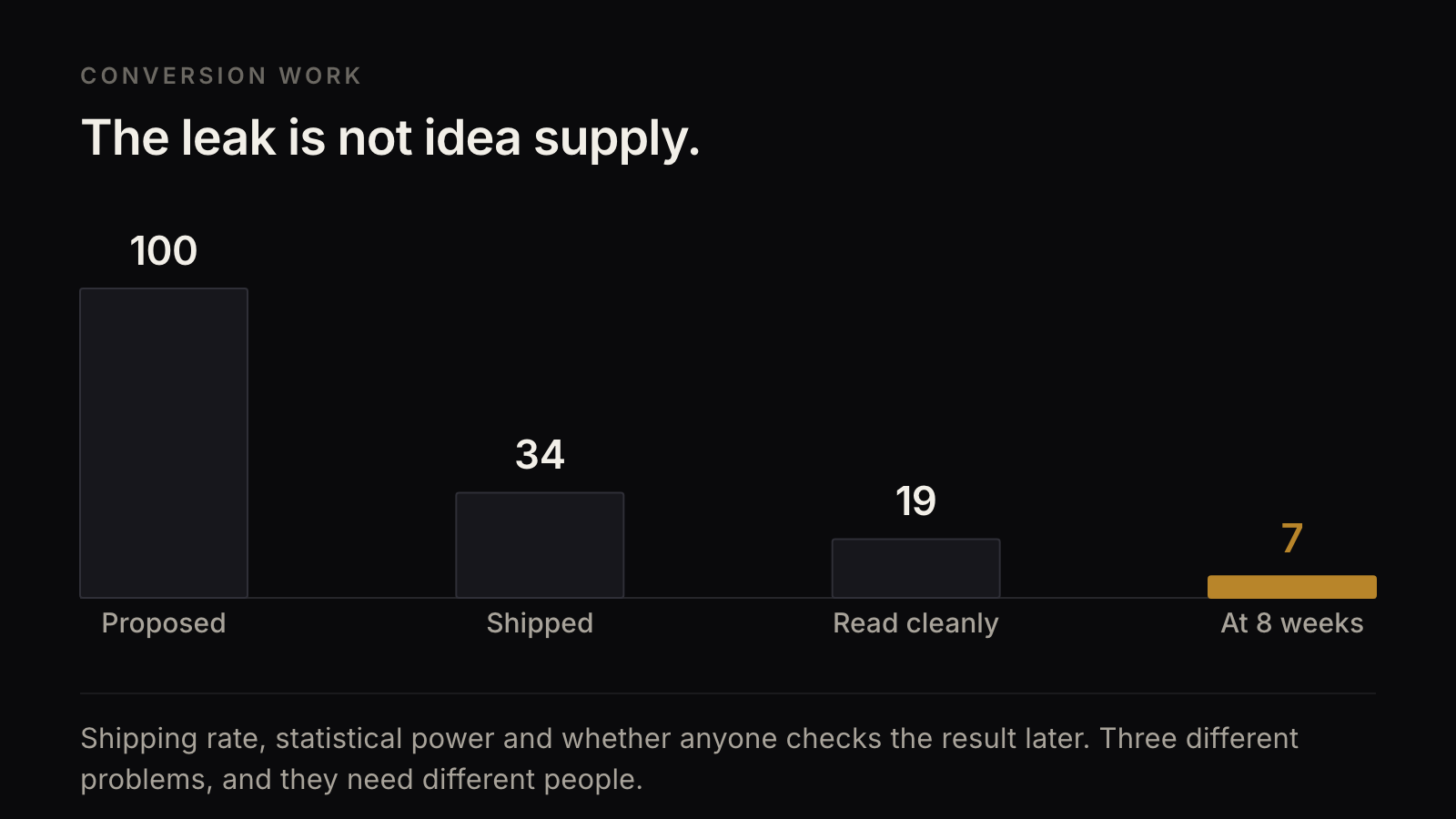
Where conversion programmes actually leak
Take a hundred test ideas from a decent audit. In a typical year, about a third get built. Of those, roughly half produce a reading anyone trusts, because the rest ran during a sale week, or on too little traffic, or against a page that changed halfway through.
Of the ones that read cleanly, a smaller group still holds two months later. The rest were seasonality, a novelty effect, or a win in one segment averaged across all of them.
The leak is not idea supply. It is shipping rate, statistical power, and whether anyone checks the result after the celebration.
That matters for hiring, because those three problems need different people. An audit gives you ideas. A developer gives you shipping rate. Only someone who owns the number will go back at week eight and tell you the win evaporated.
What a conversion consultant can own
Three jobs get sold under the same title. They are not interchangeable.
The page job. Product pages, size and shade guidance, imagery, speed, checkout friction. Real work with real returns, and the most common brief. How to improve ecommerce conversion rate covers the substance of it.
The experiment job. Designing tests that can actually settle something. Choosing what to measure, working out whether you have the traffic to detect the effect you care about, and refusing tests that cannot conclude.
The contribution job. Deciding whether a conversion rate rise was worth having. A checkout change that lifts conversion and raises returns is not a win. A threshold that lifts conversion and cuts contribution per order is a loss with good reporting.
Most engagements buy the first job and hope for the third. If your problem is that conversion rises and the month does not improve, the first job will not fix it.
Conversion rate is not one number
A site-wide conversion rate is an average of several different businesses. Paid social traffic, branded search, email and returning customers convert at rates that can differ by a factor of five.
That is why a falling conversion rate so often turns out to be a mix change. You bought more top-of-funnel traffic, the average fell, and nothing about the site got worse. Testing the product page will not recover it, because the product page was never the problem.
Before you brief anyone, split conversion by channel and by device for the same period. If the drop lives in one traffic source, you have a media question. If it lives across all of them, you have a site question. What is a good ecommerce conversion rate is the page on reading the number itself.
Do you have enough traffic to test?
This is the question that decides whether a testing programme is the right purchase at all.
Detecting a small improvement takes more traffic than most brands have. At a few thousand sessions a week and a two per cent conversion rate, a test that could find a ten per cent relative lift will take a long time, and a smaller lift will never be visible.
Below that threshold you have two honest options. Make larger changes and accept that you are making judgement calls rather than measuring them. Or spend the money on the things you already know are wrong, which in fashion and beauty is usually size and shade confidence, delivery clarity, and the number of steps in checkout.
A consultant who proposes a twelve-month test roadmap without asking about your session volume has not checked whether their method fits your business.
Fashion and beauty specifics
In fashion, conversion and returns move together, and the returns arrive later. A test that lifts add-to-cart by making the fit sound generous will book a win in week two and a cost in week six. Any conversion work on a fashion catalogue needs a returns read attached, or it is measuring half the outcome.
In beauty, the constraint is more often shade and suitability than price or friction. Confidence work on shade matching, ingredient clarity and sample routes tends to beat button colour by a wide margin. The second order matters more than the first, so a conversion win that arrives through discounting can cost you the repeat.
Both categories have a seasonality problem for testing. A test that spans a sale week has a sale week in it, not a result.
How to brief one
- Name the number you want moved, and say whether it is conversion, contribution per session, or repeat rate.
- Bring the split. Conversion by channel and device, for the last full quarter.
- State your weekly session volume honestly, so the method can be sized to it.
- Say who ships. If there is no development capacity, the engagement is an audit with extra steps.
- Agree in advance how a win is confirmed, and who checks it at eight weeks.
- Decide whether returns and discount are in scope. In fashion they have to be.
Point five is the one that gets dropped, and it is the one that separates a programme that compounds from a list of things that were once true.
TwoKai starts with the outcome. Whether the conversion work you are buying changes contribution, and whether you have the traffic to prove it. Then we engineer the route.
What's missing
This page can tell you which of the three jobs you are actually buying, where conversion programmes leak, and whether your session volume supports a testing method. It cannot tell you whether your own drop is traffic mix or the product page, or which of your tests would still hold at week eight. That needs your sessions and your order data.
Related: What is a good ecommerce conversion rate? · How to improve ecommerce conversion rate · Ecommerce consultant, agency or fractional? · Shopify consultant: what the role actually owns
If you want the split measured before you commit to a roadmap, Explore an opportunity with TwoKai.