Ecommerce consultant UK: how to buy the help
People add UK to the search for two reasons. They want someone who has traded through a British ecommerce year. And they want someone who will pick up the phone during their working day, not at nine in the evening.
Both are reasonable. Neither tells you what you are actually buying. The word consultant covers several commercial shapes, and the difference between them decides whether anything changes after the first month.
This is not a second ecommerce consultant vs agency vs fractional page. That one compares hire models by who owns the P&L. This one stays on the UK-shaped search. How the help is sold, what British trading changes, and how to scope a first piece of work you can check.
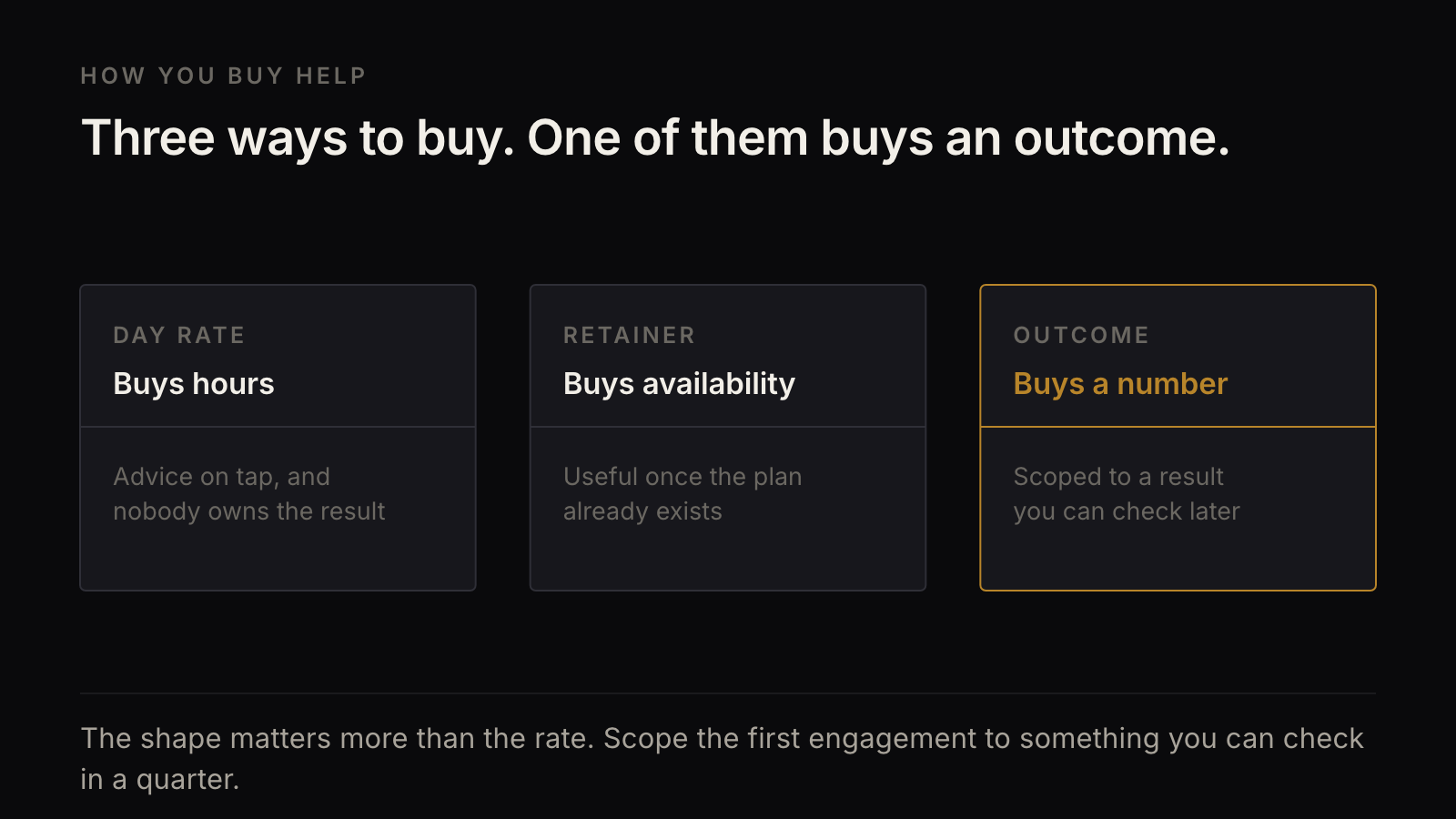
Three ways help is sold
The commercial shape matters more than the title. There are three common ones.
A day rate buys hours. You get senior attention for a defined number of days. Advice, a review, a plan, a second opinion on a supplier. Nobody owns the outcome, because nobody agreed to one. This works when your team can implement and the gap is judgment. It fails when the plan needs someone to build what it describes.
A retainer buys availability. You get a person in the weekly meeting and a claim on their calendar. This works once the plan already exists and the work is ongoing. Priorities to set, suppliers to brief, decisions to make each week. The failure mode is a retainer bought before the plan, where months pass and the invoice describes presence rather than progress.
An outcome engagement is scoped to a number. One commercial objective. An investigation into why it is stuck. A route designed around the stack you already run. Something built or briefed. Then a measurement of whether the number moved. This is the only shape where you can tell afterwards whether the money worked.
None of the three is wrong. The mistake is buying hours when you needed ownership, or ownership when all you needed was a second opinion for two days.
What UK trading genuinely changes
Some of this search is filler. Three things are not.
Duty and VAT on cross-border orders. Selling from Britain into the EU now crosses a customs border. VAT is due in the destination country, so you either register there or use a scheme that collects it at the point of sale. Duty depends on where the goods were made, not where they ship from. That catches fashion and beauty brands out constantly. Stock manufactured outside the UK and shipped on to a European customer can attract duty even under the trade agreement, because it fails the rules of origin. Then there is the question of who pays at the door. Charge it at checkout and conversion drops. Leave it to the customer and you get refused parcels and a return you did not budget for. Either way it lands in contribution.
Returns and the carrier landscape. British fashion shoppers return heavily and expect the process to be easy. The carrier market here is unusually crowded, with lockers, drop-off points and courier collection all competing for the parcel. That gives you real choice on cost and on experience, which makes the returns line a decision rather than a fixed cost. A consultant who has never priced a UK returns journey will treat it as an operations detail. It is a margin line.
Seasonality. The British trading year has its own rhythm. A discount period that now starts well before the end of November. A January sale that eats into the new season. Weather that moves outerwear and suncare by weeks. A brand that plans to an American calendar will buy the wrong depth at the wrong time.
Home market or next market
The UK is a dense, mature ecommerce market with short delivery distances. That makes it an efficient place to prove a proposition. It is also finite. A growing brand tends to hit a ceiling here sooner than founders expect, and the obvious next move is the United States.
That move changes the arithmetic rather than scaling it. Shipping is slower and dearer. Sales tax is a different regime with its own registration burden. Paid competition is deeper and the auction rarely rewards a small brand with a British creative library. Returns from a distant market often cost more to bring back than the stock is worth.
The judgment call is whether the domestic market still has room. Very often it does, and the honest answer is more depth here before more territory abroad. Customer retention in ecommerce usually holds more near-term contribution than a new country.
Timezone matters more than people expect. Trading decisions in fashion and beauty are daily. A drop lands, a size sells out, a campaign misfires by lunchtime. Someone who can look at it that afternoon beats a good answer that arrives overnight to yesterday's question.
Scope the first engagement to a number you can check
Whatever shape you buy, make the first piece of work checkable.
Name the number. Contribution per order, payback on the first product you buy traffic against, return rate on a size-sensitive line, or second-order rate without a discount code. Revenue and awareness will not do.
Name the market. If you sell into the EU as well as at home, split it. A blended figure hides the orders that lose money at the border.
Set a window you can read. Long enough to clear the returns lag, short enough that you find out this season rather than next.
Agree what gets handed back. A good partner will tell you which parts stay with your media agency or your storefront team. Treat that as a good sign.
Then ask the question that sorts the field. What will you show me at the end, and how will I know it worked? A day rate answers with a document. A retainer answers with a cadence. An outcome engagement answers with a number and a before.
TwoKai starts with the outcome. Then we engineer the route around the stack, the markets and the partners you already have.
What's missing
This article can tell you how ecommerce help is sold in the UK, what British trading genuinely changes, and how to scope a first engagement so you can check it. It cannot tell you which of the three shapes fits your constraint, or what your cross-border margin actually looks like once duty, VAT and returns are in the sum. Those answers sit in your own orders.
Related: Ecommerce consultant vs agency vs fractional · Shopify consultant: what the role actually owns · Unit economics for a Shopify fashion or beauty brand
If you want that first piece of work scoped to a number, Explore an opportunity with TwoKai.