Ecommerce automation
People type “ecommerce automation” when a person is still doing the join by hand. A weekly export. A Slack chase. A spreadsheet that decides markdown. Someone in the meeting says they need Shopify Flow, or an iPaaS, or an AI layer on the same mess.
The search is real. The useful question is not which recipe to clone. It is which commercial leak the system is for, and what class of build can sit on the stack you already have.
This is not a Shopify Flow tutorial. That SERP is Help Center and template galleries. Unbranded ecommerce automation is the open stem. Fashion and beauty belong in the examples. They do not belong forced into the slug.
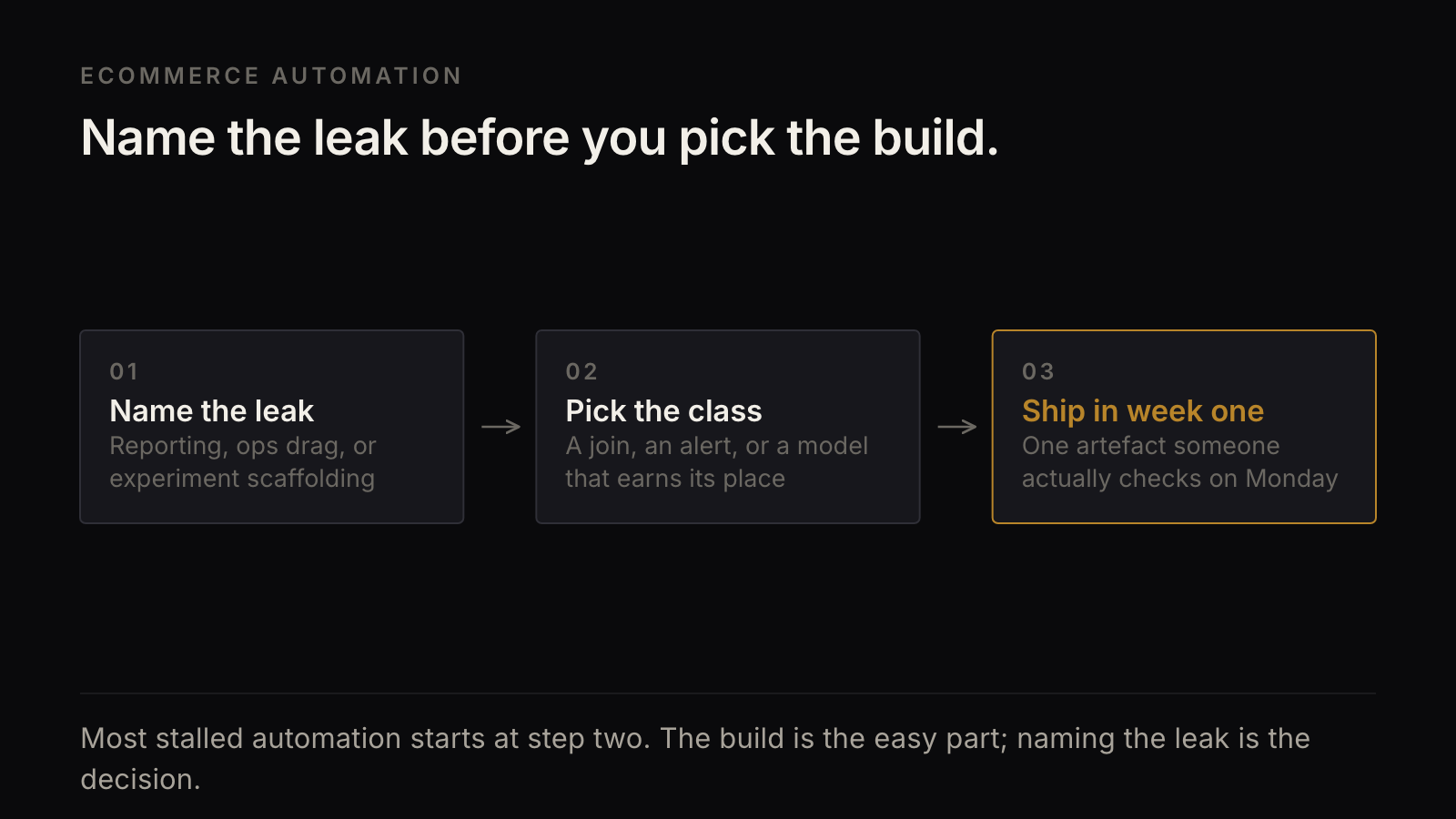
Start with the outcome, not the recipe
Automation is a means. The outcome is usually one of four jobs.
A number you can decide on. Contribution, payback, or incrementality that today lives in three tools and a slide. MER vs ROAS is the literacy sibling. This page is what gets built when the tiles disagree and a person still reconciles them.
Ops drag you can remove. Returns that wait for a spreadsheet. Replenishment that waits for a buyer to notice the two shades that actually repeat. A markdown list that is a calendar, not a diagnosis.
A test you can repeat. A holdout, a geo, a pause, a price or offer change that does not depend on one person remembering the design.
A model that earns its place. Forecast, ranking, or copy assistance when a rule or a join would not do. AI when it earns its place. Never the default brief.
If you cannot name which job you are buying, you will buy a Flow, an app, or a bot that automates the wrong Tuesday.
TwoKai starts with the outcome. Then we engineer the route. Sometimes that is automation. Sometimes it is a measurement join and no new bot.
Four classes of system
Once the job is named, the build is a class, not a vendor.
Reporting joins. Orders, ads, ESP, returns, and the offer that sat on the basket, in one place a decision-maker can use. Fashion needs the style life, not week-one ROAS. Beauty needs first SKU and whether a second order arrived without another 30% off. This is software around the stack you have. It is not a new dashboard religion.
Ops automation. A rule that fires when a condition you already trust is true. A return reason that should change the next size run. A replenishment alert on the two shades that create repeaters. A markdown flag when sell-through on a colourway is already dead. The rule is the product. The workflow tool is plumbing.
Experiment scaffolding. A way to name the change, the unit, the window, and the stop rule. So a pause or a holdout is not a heroics week. Unit economics tells you which number the test is for. The system is how you run the next one without rebuilding the sheet.
Selective models. Rank, forecast, or generate only where the join and the rule are not enough, and where you can see whether the model paid for itself. A beauty shade recommender can earn its place. A generic “AI for ecommerce” layer on a dirty export will not.
Do not start in the last class. Most briefs that say automation need the first or the second.
What a week-one artefact looks like
A useful first week is not a platform rebuild. It is evidence that the class is the right one.
You should be able to point at one leak, one system class, and one measured output.
Examples that can be owned:
- A join that shows contribution on the same paid mix, after returns, for the three SKUs you already push
- A rule that flags a fashion colourway for markdown review when full-price take-up has already died, instead of waiting for January
- A replenishment list for the two beauty shades that create a second order, instead of a seven-shade launch that looks like range
- A written stop rule for a spend pause, so incrementality is not an argument in week three
If week one is only a discovery deck and a list of apps, you hired advice. Advice can be the right purchase when you have builders. It is the wrong purchase when you typed “ecommerce automation” because a person is still the integration.
Ecommerce merchandising is the sibling when the leak is range, demand, or markdown. Do not automate the grid until you know which instrument is eating contribution.
What not to automate yet
Some work looks like automation and is still a definition problem.
If Shopify, GA4, and the ads manager do not count the same order, automating the export will scale the disagreement. If return rate is last year’s folklore, a markdown bot will fire on a lie. If the only people who convert are people with a code, an abandoned-cart flow will take credit for demand you already had.
Fix the definition, then automate the rule. The other way round writes the error into the calendar.
Fashion size returns and beauty shade misses show up after the merchandising meeting has already called the drop a success. Automating “more colourways” without depth in size or shade will look like range. It will behave like returns.
A sequence you can run this week
Keep it short. You are choosing a class. You are not finishing the build.
- Name one commercial number that is stuck. Contribution, payback, return rate on a featured line, second-order rate on a replenishing SKU.
- Write what a person still does by hand to manage it. Export, chase, guess, or wait for the calendar.
- Pick the class: join, ops rule, experiment scaffold, or a model that has to earn its place.
- Name the week-one artefact. One output you can point at. Not a platform.
If step 2 is blank, you do not have an automation brief. You have a metric argument. Have that first.
TwoKai works around the stack you already have. Shopify is common in fashion and beauty. It is not the offer. We do not sell a Flow pack, an iPaaS, or an AI layer as the brief.
What's missing
This article can name the jobs under ecommerce automation, and the class of system that fits each job. It cannot tell you which leak is yours, or which join between your orders, ads, and returns is the constraint. That design lives on your stack.
Related: MER vs ROAS: which number do you spend against? · Unit economics for Shopify fashion and beauty
If you want that investigation led as one commercial piece of work, Explore an opportunity with TwoKai.